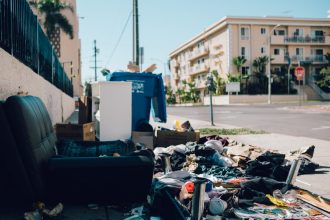
It began with one stubborn sofa that refused to leave. I watched Maria wrestle with it on her Echo Park front porch as if it were a creature from a different decade—sun-bleached upholstery, springs that complained like an old radiator. A child from the apartment above stuck his head over the rail and laughed. A siren threaded down Sunset Boulevard. Somewhere in the distance the waves whispered from Santa Monica, and for a second the whole city felt like a place where things could either be stored forever or finally shipped away.
Setup: People, Places, and the Weight of Stuff
Maria had lived in Echo Park for twelve years. Her house was a patchwork of memories: a collapsed bookshelf from a childhood home in Pasadena, a stack of kitchen cupboards that had survived a renovation in Glendale, a pile of branching Christmas lights tangled like urban vines. After a decade of collecting, the casita felt like it was closing in. “I need the living room back,” she told me, voice caught between resolve and exhaustion.
She called Omar, a contractor she’d used for small jobs in Burbank, and he recommended a dumpster company he’d worked with on a Hollywood remodel. The driver, Miguel, lived in Long Beach and knew the backroads from there to Beverly Hills. Scheduling a dumpster in Greater Los Angeles, I learned, doesn’t just involve selecting a size—it’s a choreography of timing windows, permits, narrow alleys, and neighborhood politics.
Rising Action: A City of Rules and Neighbors
The first snag came from the street. Maria’s house sits on a narrow Echo Park lane where the city’s parking signs are more like stern suggestions until the Department of Transportation shows up. “If it’s on the street, you’ll need a permit,” Omar told her, rubbing his temples. “If it’s in the alley you need clearance from neighbors. If you put it in front of your neighbor’s driveway—well, you’ll have a meeting.”
That night, the three of us walked the block under sodium-orange lights. A neighbor in a Mulholland Hills-blue convertible poked his head out, frowning. “We had a mattress pickup last month and someone left it for a week. At what point does it become the neighborhood’s problem?” he asked.
“We’ll keep it for two days max,” Miguel promised. “I’ll drop it at dawn and pick it up before sunset. No lingering.” His accent carried the sea and engine grease—Long Beach—and something quietly authoritative that seemed to reassure the block.
Between Maria’s HOA rules and the City of Los Angeles’ regulations, we had to pick our path. Santa Monica has its own beachside ordinances, West Hollywood its high-curb sensitivities, Torrance its industrial rhythms. Each city in Greater LA felt like a small kingdom with different laws about where a roll-off could sit, how long it could stay, or whether concrete blocks were allowed in the bin.
Key Insights Woven in the Story
As we negotiated, the practical lessons spilled out like the contents of an overfull dresser. Miguel crouched to measure a parking lane and explained the differences in soft, matter-of-fact tones. “You don’t always need a 30-yard. For a kitchen demo in Culver City or a cleanout in Silver Lake, a 15 or 20-yard usually does the trick. For roofing in Northridge, people often call for bigger ones because of the bulky materials.”
He pointed to the mattress: “Mattresses often need special handling—donation if they’re in good shape, or specific landfill routes if they’re not. And never put hazardous stuff in: paint cans with wet paint, compressed gas tanks, batteries, or electronics—those need separate disposal.”
Omar chimed in. “There’s a balance between cost and convenience. Some companies charge by the truck and weight. Others charge per day. If you’re in downtown LA and have to get a street permit, factor that into your budget. And if you’re doing construction debris—like concrete or dirt—you’ll pay extra because those materials are heavy.”
Maria listened, surprised at how much of the process was logistical choreography. We learned that roll-off dumpsters generally range from about 10 to 40 cubic yards, each suited to different jobs; that many Los Angeles neighborhoods require a permit for placing a dumpster on public street; and that scheduling for a weekday morning pickup is often the sweet spot to avoid traffic jams on surface streets like Santa Monica Boulevard or thoroughfares around LAX.
Scene: A Morning Delivery
Two mornings later at first light, Miguel’s truck came rumbling down the lane. The air smelled of brewing coffee and the faint tang of ocean salt carried from Marina del Rey. The truck’s engine was a low hum, and the dumpster door opened with a metallic sigh. Miguel stepped out, tall and steady, wiping grease off his hands.
“Good morning,” Maria said, clutching her hoodie. Her voice carried a nervous excitement that made the porch light seem warmer. “I’m hoping this will change everything.”
“It will,” Omar said. “One load at a time.”
They placed the dumpster carefully, parallel to the curb, sparing a neighbor’s driveway and avoiding a utility box. Miguel draped a bright safety cone and set up reflective markers. The scene felt ceremonious—like watching a small army prepare for battle against accumulated objects.
Rising Action: The Decisions That Needed Making
What went in first mattered. Maria wanted to start with the big, emotional items: the couch, the old dining table. Omar suggested staging: “Put hazardous or bulky materials—like the old refrigerator—near the top so we can separate them for proper disposal. Keep donation-quality items on the side so they don’t get crushed under rubble.”
By noon the dumpster was a mosaic of choices: a lamp that had survived three moves, a cracked vase, a stack of VHS tapes, and cardboard flattened into neat sails. We filled the air with the clack of tool handles and the quiet conversations of neighbors who had come to watch, offer opinions, or hand over forgotten items from their garages. “Do you know where these go? I thought maybe Goodwill?” asked an elderly man from across the street, holding a box of books. “Yes—donate, recycle if they’re ripped, and electronics go to e-waste centers,” Maria replied, feeling the authority of someone reclaiming her space.
Key Insights Continued: Green Choices and Hidden Costs
Between lifts, Miguel explained how companies in Greater Los Angeles often partner with local transfer stations and recycling centers. “We try to divert as much as possible,” he said. “Wood can sometimes be chipped and turned into mulch at certain facilities, metals get recycled, and clean drywall might be repurposed depending on the project.”
He added a practical tip: “If you can separate materials—metal, wood, cardboard—you save on weight and sometimes on fees. And schedule pickups off-peak if you can. LA traffic isn’t just annoying; it costs time and money for everyone involved.”
We also learned about fines: leaving a dumpster longer than the permit allows could trigger citations from the city; blocking a driveway could invite complaints from neighbors; and overfilling could spill debris onto the street, creating safety hazards and additional cleanup fees.
Resolution: A Neighborhood Transformed
By late afternoon the casita’s living room breathed again. The sun angled low, gilding the palm trees and casting long shadows across the lane. The dumpster contained the detritus of a life reordered: a mattress, boards, boxes of old magazines, a broken television—things that had weighed down Maria’s days and corners.
Neighbors came by with cold drinks. The man with the blue convertible clapped Maria on the shoulder. “Looks good,” he said simply.
“It feels like we got our house back,” Maria said, smiling in a way that made the porch look younger. She handed Miguel a paper sack of fresh tamales as thanks. He shook his head, amused and touched. “Keep them for the crew,” he said. “We’ll make the next pick-up quick.”
Before the truck left, Miguel made a last sweep, collecting a separate small bag of electronics and batteries. “These go to the e-waste depot in Vernon,” he said. “We track where they go; it’s better for the city and for the next person who might use those parts.”
Takeaway: What to Remember
If you live in Los Angeles, Glendale, Long Beach, Pasadena, Santa Monica, or any of the surrounding cities, remember this: a dumpster is more than a metal box. It’s a plan that involves timing, permits, material separation, and a neighborhood conversation. Pick the right size, ask about weight and hazardous restrictions, offer donation-worthy items a second life, and book pickups during off-peak hours when possible. Speak kindly to your neighbors—clear communication smooths a lot of friction. And finally, treat disposal as a step toward something: a clearer room, a simpler schedule, a lighter load.
When Miguel drove away, the truck’s taillights blinked like a pair of patient eyes. Maria stood on her porch and watched the sunset melt behind the hills of Hollywood and the chrome of a distant downtown high-rise. The living room smelled faintly of dust and lemon from the cleaning spray we used. It felt like the hush after an old song stops playing and a new one begins. The sofa that had resisted every attempt at removal for months was now gone. The city around us kept humming—traffic, conversations, sirens, waves—proof that life in Greater Los Angeles never truly pauses, but sometimes it rearranges itself into something calmer, clearer, and ready for whatever comes next.
Outside, the sky deepened to indigo. A palm tree silhouette cut across a sliver of moon. Maria locked her front door and, for the first time in a long while, thought about where she would put the bookshelf she’d always wanted. Miguel’s truck disappeared into the lattice of streets, and the block exhaled. The dumpster’s echo—its empty space—was the quiet promise of order in a city that always seems to be making new stories.