It was the smell of diesel and sawdust that woke Maria before dawn — a gritty perfume of change drifting through the open window of her Silver Lake bungalow. Outside, a hulking green roll-off sat half on the curb and half on the scuffed asphalt, dwarfed by palm silhouettes and the soft glow of streetlights. By noon, the dumpster would be gone, and her house would stop feeling like a project and start feeling like a home again. But between now and then lay the choreography of permits, pickups, neighbors, and decisions that would teach her the language of dumpster removal across Greater Los Angeles.
Setup: The House, the Crew, and a City That Never Stops Remodeling
Maria had moved from Boyle Heights to a three-bedroom in Silver Lake six months earlier. The place had charm — original hardwood floors, a crooked kitchen window, and a backyard rosemary bush that smelled like the Mediterranean. It also had a bathroom from the late 1970s that needed to be wrestled into the present.
‘We can gut it in a week if the permit goes through,’ her contractor, Javier, said the evening he measured the vanity. He was part mechanic, part counselor — quick with a grin and with the clank of a tape measure against palm trees. ‘But we need a dumpster for the junk. Trim, tiles, cabinets — and don’t forget the old tub.’ Javier’s phone buzzed with routes, a sign of the daily tangle of Los Angeles logistics.
In the days that followed, Maria learned the faces and places that make up LA’s behind-the-scenes refuse ballet: a dispatcher in Long Beach arranging the roll-off, a city clerk in Echo Park granting a curbside permit, and a driver in Burbank who could thread a ten-yard container down a narrow alley without nicking a mailbox. The city itself was a character in the story — a mosaic of neighborhoods from LA’s skyline in Downtown to the surf-lined avenues of Santa Monica, each with its own rules and rhythms.
Rising Action: Tight Streets, Tight Timelines, and the Neighbor with a Watchful Eye
On the day the dumpster arrived, the neighborhood was awake. An elderly neighbor across the street, Mrs. Lin, came out in her slippers. ‘This is the third house this month,’ she said, peering at the metal rectangle. ‘Where do they take all that stuff? I always think of the ocean.’ Her voice gathered concern and curiosity in equal measure.
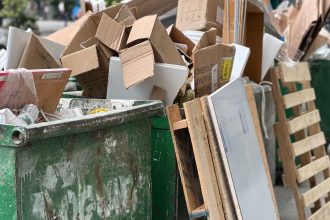
Javier and his crew moved like a rehearsed band. They wrapped the tub in plastic, stacked broken tiles in neat rows, and hitched a hand truck to a pile of hand-me-down fixtures. Dust hung in the air, sparkling in the morning sun. The dumpster hummed with activity — the clatter of ceramic, the thud of drywall, the brief scrape of a sledgehammer. By late morning, the pile reached the top rim, a collage of plywood, metal, and old grout that smelled faintly of bleach and citrus from the cleaning rag someone had tossed in to be polite.
Then a small crisis: a permit inspector from the City of Los Angeles called to say the permit had been misplaced. Suddenly, what looked like a routine pickup became a race against the calendar. If the dumpster wasn’t retrieved by the end of the day, overflow fees and an extra day’s rental would add surprise costs to Maria’s budget. Javier dialed the dispatcher in Long Beach; the driver in Burbank rerouted through Culver City. Traffic on Sunset threatened to stall everything — but the driver talked his way through, an apologetic grin for everyone he passed.
‘We’ve done this on tighter spots in Hollywood,’ the driver told Javier as he checked the chain lock. ‘You gotta wedge it in and respect the car alarms.’ He chuckled, but his hands were steady and experienced. That steadiness was the difference between a smooth removal and a neighborhood headache: competent crews know how to work with LA’s narrow streets, parking rules, and impatient meters.
Key Insights: What Maria Learned Between the Planks of a Dumpster
As the day unfolded, practical wisdom came in bites and in the grooves of the wood they tossed. Here are the lessons Maria collected and the things every Angeleno should know about dumpsters and removal.
1) Choose the right size: Dumpsters commonly used for home renovations come in 10, 15, 20, 30, and 40-yard sizes. For a bathroom gut in Pasadena or a garage cleanout in Burbank, a 10- or 15-yard roll-off often suffices. For major remodels in West Hollywood or whole-house flips in Echo Park, 30-yard options are more realistic.
2) Permits matter: Curbside placement usually needs a permit from the local city — whether you’re on a quiet street in Glendale or a bustling block in Downtown LA. Permit processing times vary: some cities grant same-day permits; others require applications days in advance. If you plan to block a lane or reserve a parking space, start early.
3) Know what’s prohibited: Hazardous materials — paint, solvents, batteries, asbestos, and certain electronics — can’t go in standard dumpsters. LA County runs hazardous waste drop-off events and facilities in neighborhoods like Inglewood and Long Beach. Donating salvageable items to organizations in Hollywood or Culver City can keep usable materials out of landfills.
4) Weight and load distribution: Dumpsters have weight limits. Exceeding them leads to overage fees. Heavy materials like concrete, tile, or dirt can chew through weight allowances quickly, so plan accordingly or rent a smaller dumpster but schedule more trips if needed.
5) Recycling and disposal options: Many haulers separate metals and wood for recyclers in Vernon or transfer stations toward the port. Granite countertops or copper piping may have resale value. Ask the hauler about diversion rates and whether your debris can be sorted for recycling rather than simply being hauled to a landfill.
6) Timing and traffic: Schedule deliveries and pickups outside rush hours when possible. A mid-morning pickup on a North Hollywood street can be faster and cheaper than one trapped in the two o’clock gridlock across the 101.
Every nugget of information was punctuated by small practicalities. Javier showed Maria how a tarp prevents windblown trash. The driver explained why he chains the back of the roll-off for safety. Mrs. Lin, who once ran a thrift store, suggested donating old ceramic basins rather than tossing them — a reminder that community resources exist even in a sprawling city.
Resolution: The Pickup, the Thank-Yous, and the Little Rituals of Closing a Chapter
By late afternoon, the city inspector finally faxed the permit confirmation. The driver backed the truck down the block with a practiced grace, the engine’s rumble mixing with the distant rush of the 5 Freeway. Neighbors flocked to the sidewalk as if for a parade: teenagers from down the street, a dog that barked encouragement, and Mrs. Lin with a paper cup of lemonade. ‘Look at that,’ she said, squinting at the dumpster. ‘It’s like the neighborhood breathed out.’ Maria laughed, a real sound this time, the kind that dissolves tension.
Loading the dumpster was a performance and a release. Each discarded tile was a small casualty of progress; each slammed cabinet came with a story of the family who had once cooked at that stove. Javier’s crew made an effort to keep good pieces aside for donation: a vintage light fixture wrapped in old newspaper and a mirror with a gilt edge that caught the late sun like a promise. The driver hooked the chain, and with one slow rise the container left the curb, rooftop silhouettes cutting the sky as the truck pulled away toward Vernon’s sorting yards. Maria felt the house exhale; the work was still ahead, but the worst of the disruption had been.cleaned away.
‘We’ll come back tomorrow with a smaller bin for the wood scraps,’ Javier promised as he shook Maria’s hand. ‘And if you need help hauling those pieces to the salvage shop, I’ll call my cousin in Long Beach.’ It was a human exchange, small logistics buoyed by community ties. For Maria, the dumpster’s departure was a visible hinge closing one part of the renovation story and opening another.
Takeaway: What to Remember When You Need a Dumpster in Greater Los Angeles
There’s a rhythm to renovation in LA — the hum of traffic, the clank of tools, the papers of permits fluttering in gusts. If you find yourself needing a dumpster in Los Angeles, Pasadena, Santa Monica, Long Beach, Burbank, or any of the city’s neighborhoods, remember these essentials: pick the right size, secure permits early, separate hazardous materials, ask about recycling and diversion, and plan around local traffic. Most importantly, treat the process as part of the community fabric. Talk to neighbors, donate salvageable items, and choose a hauler that communicates clearly and respects your street.
As the sun dropped behind downtown’s steel and glass, Maria stood on her porch with Mrs. Lin and a cup of cold lemonade. The street smelled faintly of rosemary from the backyard bush and of distant ocean salt that only Los Angeles neighborhoods borrow. The dumpster was a memory now — a flattened sound in the mind, a gap where clutter had been. Behind the tidy facade, new tiles waited in boxes, and tomorrow Javier’s crew would begin the careful work of assembling what was next.
There is a small ritual in watching a dumpster vanish down an LA street: a finality that smells of sawdust and citrus, the flash of a safety vest, the echo of tires against asphalt. In that space between the old and the new, Maria felt a city-sized possibility settle over her roof. It was the kind of quiet that made you want to sweep the porch and put the kettle on — not because the work was done, but because it was, for the moment, moving in the right direction.
That evening, as a golden light warmed the skyline from Santa Monica to Downtown, Maria set her cup on the kitchen counter and ran a hand along the empty space where the tub had been. The house had room now, not just for renovation, but for the lives that would fill it: laughter, cooking smells, and the occasional clatter of a dropped spoon. The dumpster had been both an end and a beginning — a necessary, honest piece of the city’s ongoing story of making, undoing, and remaking.
And somewhere on a truck headed past the port, the last of the day’s debris rolled toward sorting yards and recycling centers, catching the sunset like a promise that what we discard can still have a second life.