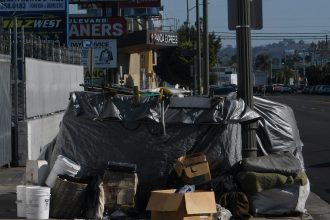
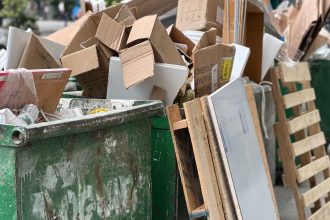
The diesel-scented morning in Echo Park arrived with a clatter—a roll-off dumpster thudded into place beneath a Victorian awning, metal chains singing as the driver backed away. Maria stood on the stoop, palms on the railing, watching a small army of neighbors and strangers begin to carry pieces of a lifetime down the creaking stairs. Somewhere in the distance the 101 hummed like a restless insect; seagulls argued above Santa Monica. This was not just junk; it was the archive of a life moving on, and the dumpster was the hinge.
Setting the Scene: A House, a Neighborhood, a Decision
Maria’s brownstone sat on a sun-dappled block that might have belonged in a photograph: sycamores cast lacey shadows on the sidewalk, bicycles leaned against a lamppost, and a barista waved to a regular across the street. The house smelled of lemon oil and old paper, and the attic’s heat made the afternoon feel like a slow breath. She’d decided to sell, but first came the demolition of memory—out went the faded prom dresses, the cracked pottery, a desk scarred by decades of homework and tax returns.
“We need a dumpster,” she said to me, voice soft but decisive. “Something big enough for a kitchen, but small enough to fit on my street without the city breathing down our necks.”
That single sentence set us on a circuit around Greater Los Angeles: calls to companies in Culver City, a permit check with City of Los Angeles Bureau of Street Services, a detour to Pasadena to drop off a lamp that was too delicate for tossing, and a stop by Venice to donate a stack of surf magazines to a coffee shop that loved vintage paper. Each city offered its own rules, smells, and personalities—and each had to be navigated to make the dumpster process work.
Rising Action: Permits, Narrow Streets, and the Weight of the Past
Getting a dumpster in Los Angeles is rarely as simple as pointing at a house and saying “drop it here.” On Ocean Park Avenue in Santa Monica, we learned that the city treats any placement on the public right-of-way—especially curbside parking—as a permit situation. The clerk at the permit office explained over the phone how a temporary parking permit might cost extra and require specific signage.
“If you block a bike lane, you’ll be hearing from more than just the neighbors,” she warned. Her voice had the practical calm of someone who’d seen too many blocked lanes and too many angry cyclists.
In West Hollywood a few days later, our truck driver cursed under his breath when a delivery van squeezed past a narrow lane. In Burbank, a homeowner needed a 20-yard roll-off for a kitchen remodel; the driveway was gated, so the crew had to strategize placement and timing. At the Glendale cul-de-sac, a reluctant homeowner insisted the dumpster not touch the delicate slate paving. Each detail—the angle of a driveway, the shadow of an oak, HOA covenants—added friction, and the family’s memories added emotional weight.
Loading the dumpster was another story. It was hot in June; sweat stung our eyes as we wrestled a sagging couch down staircases. The dumpster’s steel edges were warm to the touch. The soundscape was a collage: the metallic ring of a crowbar, the muffled thump of a mattress landing, neighborly chatter, and once, a child’s delighted shriek when a bicycle emerged from an attic trunk like a small dinosaur returning to the sunlight.
Key Insights Woven Into the Story: Practical Lessons Between the Drops
As we worked, practical questions begged practical answers. How big is big enough? Dumpster sizes—often listed as 10, 20, 30, and 40 cubic yards—translate to different projects. A 10-yard unit is shoehorned ideal for small cleanouts or garage clearances, while 20 yards suits many home remodels. For full-house gut jobs, a 30 or 40-yard dumpster might be necessary. Maria rented a 20-yard for the kitchen and a 10-yard for the attic purge; this combination kept costs manageable and placement feasible on her narrow Echo Park street.
Cost, of course, varied across neighborhoods. A basic roll-off rental in Inglewood or Torrance could look different on paper than one in Beverly Hills. Why? Travel time, permit requirements, drop-off difficulty, disposal fees at transfer stations, and local landfill or recycling rates all feed into the final quote. We learned to ask for an itemized estimate: delivery, permit assistance, weight allowance (often measured in tons), overage fees, and haul-away.
“And watch for prohibited items,” the driver advised, wiping his hands on a rag. “Batteries, paint, solvents, tires, and anything with asbestos—those go elsewhere. If you toss them in, you can get fined.”
He was right. Hazardous materials are handled differently: call your city’s household hazardous waste program—Los Angeles Sanitation offers regular drop-offs—or arrange a specialized pickup. Similarly, electronics often require e-waste routes; Goodwill stores or certified recyclers in Long Beach and Pasadena accept some items for donation or recycling.
Another important lesson: staging the dumpster. On a steep Venice alley, we bent a little and placed wooden planks to protect a cobblestoned driveway. In Pasadena, the HOA asked for a protective mat under the dumpster. Small precautions save big headaches.
Human Moments and Emotional Salvage
Not everything we loaded was trash. Maria pulled out a wooden box of letters, tied in twine, and sat on the lip of the dumpster, letting a breeze tease the envelopes. “My father wrote these during the ’70s,” she said. Tears pooled. We stopped loading. A neighbor, who’d been handing down old picture frames, leaned in and said, “Keep the box. Let the dumpster take the rest.” She did. Later, she told me the buyer appreciated the gesture—the house felt loved.
We made phone calls to salvage what we could. An old lamp found a new life in a coffee shop on Abbot Kinney. A chipped dresser went to a furniture restorer in Glendale. The mattress whose springs had squealed for years was scheduled for pickup at a recycling center that separates foam from metal. That day, the dumpster became a crossroads: some things went to the landfill, some to recycling, and some to a new home.
Logistics and the City Maze
One evening, after a long day of hauling, we waited for a city inspector in Highland Park who had to sign off on a temporary permit. Streetlights flicked on; the air cooled and smelled like jasmine. He arrived on a bicycle, clipboard propped under his arm.
“We try to make it easy,” he said, stamping the paper with a soft thud, “but we also try to keep the street safe. You block too much parking and you inconvenience too many people.”
The permit process differs across jurisdictions. Los Angeles proper requires certain signage and possibly an encroachment permit if the dumpster sits in the public right-of-way for more than a few days. Santa Monica and Beverly Hills have stricter aesthetic and timeline rules. In Inglewood or Long Beach, lane restrictions and commercial neighborhoods might change time windows for deliveries. Knowing the rules ahead of time—by calling the city’s public works or permit office or asking your rental company for permit assistance—smooths the path.
Resolution: The Last Haul and the Quiet After
On the final day, the dumpster driver hooked up to the steel hooks, listened to the hydraulic chug, and the dumpster rose like a giant metal stomach drawing breath. The truck pulled away, and for a moment the block felt oddly lighter. We stood and watched the empty lot where a mountain of clutter had been—an open space that smelled faintly of old paper and lemon oil, touched by the late-afternoon sun. Across town, the skyline behind Bunker Hill glowed, and the hills up toward Toluca Lake turned a deepening purple.
Maria clapped us on the back, quiet and grateful. “It feels strange,” she said. “Like the house exhaled. But also—ready.” Her voice was steadier than it had been at the beginning.
Takeaway: Practical Advice for Anyone Clearing Space in Greater Los Angeles
If you find yourself standing on a stoop with a stack of belongings and a choice to make, remember these practical points woven into our days across Los Angeles:
- Size matters: match the dumpster size to the project—10-yard for small cleanouts, 20-yard for kitchen remodels, 30–40 yards for full-gut projects.
- Ask for an itemized quote: delivery, weight allowance, disposal fees, permit support, and overage charges.
- Check local rules: different neighborhoods—Santa Monica, Pasadena, West Hollywood, Long Beach—have different permit and placement requirements.
- Protect surfaces: use boards or mats for delicate driveways; confirm HOA restrictions early.
- Separate hazardous materials and e-waste: use household hazardous waste drop-offs or specialized recyclers in LA County.
- Donate what you can: Goodwill, Habitat for Humanity ReStores, and local thrift shops will often accept furniture and usable items.
- Communicate logistics: inform neighbors about delivery days, parking impacts, and pickup windows to reduce friction.
Most importantly, give yourself space to mourn and celebrate. A dumpster is a practical tool, but the act of clearing can be an emotional ritual—like Maria’s twine-bound letters or the lamp that found a second life by the beach.
When the last piece was gone and the truck’s taillights disappeared into the evening traffic on the 10, I walked back to Maria’s stoop. The street smelled of grilled onions from a taco truck down the block, and a sliver of twilight cut the skyline. The yawning void where belongings had been was not empty; it was potential. A neighbor brought over a bottle of wine. Children chased a soccer ball along the curb. In the distance, the lights of downtown blinked awake, and the city—always in motion—kept moving, lighter by one house, kinder by one cleared memory. The dumpster, once full of lifetimes, was now an empty echo, and the night folded over it like a soft blanket.