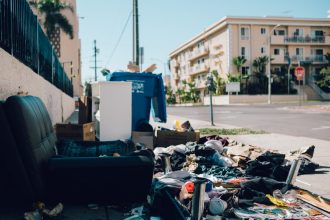
By dawn the alley in Echo Park smelled of diesel and orange blossoms—an odd, unmistakable Los Angeles perfume. Sunlight sheeted down the sides of bungalows, glinting off a steel rectangle that looked, at first, like an island washed ashore: a 20-yard roll-off dumpster parked half on the curb and half in the street, its black mouth yawning, already half-full with plaster, old kitchen cabinets, and a nest of broken tile. Maria stood on her front steps, coffee cooling in her hand, watching three men in neon vests argue over angles and permissions as if they were choreographing a complicated dance.
The Job and the People
Maria had bought the 1920s craftsman in Silver Lake with visions of sunlit rooms and a rooftop garden, but what arrived first was demolition. The contractors had promised this week, and the dumpster company—an old friend of her contractor—had delivered with a punctuality only Los Angeles streets could stage. Luis, the driver, smelled of motor oil and citrus, a habit picked up from years on the road.
‘We can fit it if we cantilever it slightly,’ he said, squinting at the narrow alley. ‘But the city inspector might want a permit if any of the wheels ride on the street.’
‘A permit?’ Maria repeated, picturing a bureaucratic delay turning her budget into a mirage.
‘Every city in this county is its own orchestra,’ Luis said with a laugh. ‘Los Angeles sings a little different from Santa Monica or Long Beach, and Beverly Hills hums its own tune. You never know till you call.’ He tapped his phone, then added, ‘Don’t worry. We’ll call DOT. Maybe we can park it on private property instead.”
Across the street, Mrs. Chen from Pasadena poked her head out, disapproving eyes softening when she saw Maria’s exhausted smile. ‘Keep it tidy,’ she advised. ‘And cover it at night. You know the raccoons in Culver City—worse than teenagers.’ There was a communal comfort in that admonition, a Los Angeles neighborliness that showed up when a project threatened to spill beyond one property line.
When Things Got Tight
The rising action felt literal and figurative over the next three days. Demolition was messy in ways the renderings at the architect’s office had not prepared them for: plaster dust that settled into the grooves of the hardwood, a rain of nails like tiny silver regrets, and the heavy, stubborn scent of old paint. The dumpster filled fast. The contractor, a blunt-spoken woman named Priya, juggled subcontractors and schedules with the tense grace of a filmmaker calling ‘quiet on set.’
‘We need that dumpster emptied by Friday,’ she told Luis one afternoon, wiping soot from her forearm. ‘My crew can’t work around that pile.’
‘We can do a swap,’ Luis replied. ‘Same-day retrieval if we schedule it and there’s access. Or we can bring a second container—if you want to pay the extra drop fee.’ He said it gently, like someone discussing shipping options with a client who already had enough to worry about.
Parking became a skirmish of its own. In Venice, where Caroline, Maria’s friend, lived, city ordinances required covered containers on public streets during certain hours to protect beach aesthetics. In Hollywood, the narrowness of the historic districts meant only smaller dumpsters could be used, and any violation could become a ticket that cost more than a week’s worth of concrete. Maria learned to think in inches—how far from the curb, whether the container’s doors would impede traffic, the angle the truck needed for a safe drop-off.
There were moments of near-disaster. A confused pick-up tried to take a turn too sharp and a neighbor from Burbank leaned out of his window, cursing and laughing at the same time. Once, a delivery missed its mark and a pile of sheetrock tumbled out, creating a mini-shoreline of white dust. The sound of the tumble was like a small meteor shower, followed by an immediate silence where everyone simply stared, calculating the prices and the solutions.
What I Learned About Dumpster Removal in L.A.
Amid the chaos, practical lessons arrived like footnotes to the drama. The city of Los Angeles, like the other municipalities in the county—Santa Monica, Pasadena, Long Beach, Torrance, Glendale—has its own set of rules. These are the key insights Maria learned, woven into the story of her renovation because practical knowledge made the burden lighter.
First: size matters. Roll-off dumpsters come in typical sizes—10, 20, 30, and 40 yards. For a kitchen remodel, a 20-yard box is often enough; whole-house demo tends to require 30 or 40 yards. Maria had misjudged at first and paid a little extra for the swap; that cost stung, but it was still less than the time lost waiting for multiple small drops.
Second: permits and placement. If a dumpster will sit on city property—curb or street—it usually needs a permit from the local Department of Transportation or public works. Fees vary. Some neighborhoods, especially historic districts in Pasadena or beachfront areas in Santa Monica, have ordinances that require covered containers or barriers to keep debris off the sidewalk. If you have an HOA in Beverly Hills, Culver City, or Malibu, check their rules before scheduling a drop-off. Mr. Chang in Glendale once told Maria, ‘Rule one in L.A.: assume the city knows about it before you do.’
Third: what’s allowed. Hazardous materials—batteries, fluorescent tubes, asbestos, certain paints and solvents—cannot go into standard dumpsters. Electronics and appliances often need separate recycling or special pickup. Many dumpster companies will advise and arrange alternative disposal for hazardous items, but those services cost extra. Maria boxed up several old cans of stain and arranged a hazardous waste drop-off at a local transfer station rather than risk a surprise fee.
Fourth: weight limits and pricing. Dumpsters come with weight limits; going over adds overage charges that can climb fast. Pricing structures vary: some companies charge by the day, others by flat rental periods, plus haul fees and disposal costs. Always ask for an itemized quote. Luis wrote everything down for Maria on a greasy receipt: rental, permit handling, overweight estimates, and a promise to call if anything changed.
Fifth: timing and logistics. Los Angeles traffic is an organizer’s nemesis. Scheduling pick-ups at off-peak hours can save time and money. Also, ask if the company offers same-day or next-day service in case of unexpected fill rates—many companies will if they have the trucks available, especially around busy neighborhoods like Silver Lake, Hollywood Hills, or Downtown L.A.
Finally: reductions and reuse. Maria refused to let functional cabinets and fixtures go straight into the landfill. She posted photos for donation on Nextdoor and coordinated with a local nonprofit in Long Beach that picked up usable materials. Reusing or donating can reduce costs and give items a second life, which in Los Angeles feels especially satisfying amidst so much reinvention.
The Last Haul
By the final day the neighborhood had a different rhythm. The dumpster, once a hulking, inconvenient monument, now looked like a patient receptacle that had done its duty. Priya audited the site with the kind of precision that made contractors look like surgeons. Nails had been raked, wood stacked for reuse, and dust swept into neat piles. Maria’s neighbors stopped by with lemonade; Mrs. Chen admitted she had been wrong about raccoons but right about covering at night.
‘You did a good job,’ Luis said, as he climbed back into his cab. ‘We’ll take this away, and you’ll have a clean curb again. Don’t forget to check your street-meter rules—some cities charge if you leave a blank space on the curb too long.’ He smiled, a quick, professional warmth.
The truck backed up slowly, the mechanical breath of its engine mingling with the distant roar of the highway. Palm trees sliced the sky into staccato silhouettes. As the dumpster lifted, the clank of chain and metal sounded final, like a curtain falling at the end of a long act. Maria felt, absurdly, like she could breathe the city in differently—less cluttered, more possible.
What to Remember
If Maria’s story has a takeaway, it’s that dumpster removal in Greater Los Angeles is less about brute force and more about choreography—timing, rules, cooperation, and a little foresight. In a county that stretches from the cliffs of Malibu to the ports of Long Beach, every neighborhood has a personality and a policy.
Before you schedule a dumpster: measure your space, estimate volume, and check local regulations. Ask for an itemized quote, clarify what cannot go in the container, and consider donating usable items. Think about timing around traffic and deliveries; schedule permits if the container will touch public property. And remember small conveniences: covers for night, locks if you fear illegal dumping, and tarp straps if you expect wind on an exposed street in Santa Monica or Venice.
When Luis drove away and the last glint of steel disappeared around the corner toward the freeway, Maria stood on her porch amid the scent of sawdust and late afternoon sun. The street looked almost ordinary again, but the house behind her was changed. Where there had been a hiccup of demolition, there would soon be a kitchen with a window facing east and a little cedar bench for morning coffee. She thought of the dumpster not as an ugly necessity but as a temporary stagehand, clearing the set so a new scene could begin. In Los Angeles, reinvention depends on machines like that: loud, awkward, indispensable.
As the evening settled, a breeze from the ocean—faint, salted—rolled in from Santa Monica, carrying with it the smell of barbecue from a house two blocks over. Maria tossed the last of the packing tape into a small recycle bin, watched a neighbor sweep grit from his stoop, and felt the city exhale with her. A final image remained: the empty curb, sun turning the pavement gold, and the silhouette of the hills framing a town that never stops remaking itself.