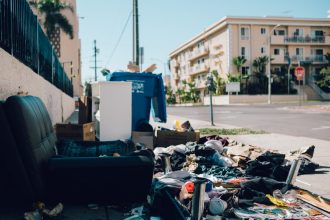
The first time I saw the orange roll-off parked on the curb of my Echo Park street, I thought it was a movie prop left over from a downtown shoot. It thumped like a sleeping giant, paint scabbed and proud, a graffiti heart on its side. A woman across the street—Mrs. Alvarez from the duplex—waved a paint-splattered hand and called, “You can’t miss it. It’s like our new landmark.”
Hook: The Dumpster That Changed a Block
Someone had tossed out an old life into that steel maw: rotting couches, a piano bench with a missing key, a family of cardboard boxes stamped with addresses from Santa Monica to Burbank. We all watched for the driver to return, half expecting him to be a character in a noir film—sun-glint sunglasses, cigarette, a shrug. Instead, a young man in a neon vest named Miguel walked down the street whistling, clipboard in hand, his cap stamped with the name of a local hauling company. He smiled, tapped his phone, and within minutes the dumpster was emptied like a stage being struck between scenes.
Setup: Who Needs a Dumpster in Greater Los Angeles?
In Los Angeles, dumpster removal is as varied as the neighborhoods themselves. I began to notice that dumpsters solved problems I hadn’t realized were problems: the contractor renovating a Spanish bungalow in Pasadena who needed a 20-yard container for tile and lathe; the film crew in Burbank clearing a set between takes; the Torrance homeowner finally tackling decades of garage accumulation; the small coffee roaster in Long Beach making space for a second roaster. Each use came with its own rhythm—scheduling, permits, the clatter of debris under L.A.’s soft light.
Miguel sat on the bumper and answered my questions like he had all day. “You’d be surprised,” he said. “From Venice boardwalk cleanups to full-house gut jobs in Glendale, we haul the city’s stories away so new ones can start.” He explained that most residential projects in L.A. fit into three common dumpster sizes: 10-yard for small cleanouts, 20-yard for medium renovations, and 30-yard for larger demolitions. “Pick the right size or you’ll pay for the wrong one,” he shrugged. “Or you’ll trip over something you didn’t expect.”
Rising Action: Permits, Neighbors, and the Unexpected
The story deepened when our neighbor, Marcus, decided to rip out his backyard patio. He called a reputable company and booked a 30-yard dumpster. The company advised him to get a street permit for the curb space in front of his Craftsman in Highland Park. Marcus assumed permits were paperwork for the faint of heart; he didn’t expect an inspector from the city to ask where the dump truck would park on a Wednesday morning when garbage day and a farmer’s market shared the block.
On permit day, Mrs. Chen from the HOA marched over, hands on hips. “You can’t block the street my son uses to park his vintage Honda,” she declared. Marcus tried to explain the schedule—three days only—but the tension rose like heat from blacktop on a July afternoon. Miguel, with a calm that comes from hauling trouble away for a living, suggested a compromise: schedule pickups early, rent a smaller dumpster, or apply for a temporary no-parking permit. “It costs a little, but it keeps the peace,” he said. That negotiation saved the project and probably a few friendships.
Then there was the afternoon in West Hollywood when an inspector opened a box and found cans of oil-based paint and a rusty can of solvent. “Hazardous waste,” she announced. The contractor froze, and the dumpster became a hazard scene. We learned the hard rule: certain materials—batteries, solvents, asbestos, medical waste—do not belong in roll-offs. They require special handling, separate manifests, and, often, higher fees.
Key Insights: What I Learned About Dumpster Removal
Between conversations with drivers, conversations with contractors, and a few late-night searches for “dumpster laws Los Angeles,” a set of practical truths emerged, stitched to the city’s landscape like tram lines through downtown:
Size matters—A 10-yard dumpster is the handyman’s friend: small furniture and yard waste. A 20-yard is the renovation workhorse, holding drywall, cabinetry, and flooring. A 30-yard answers the call of full-gut remodels and roof tear-offs.
Permits and parking—Most street-placed dumpsters require a permit from the local municipality. In Los Angeles, Glendale, Pasadena, or Santa Monica, rules vary. For example, curb placement in Santa Monica often involves stricter beach-community guidelines; Burbank’s film-heavy areas may require coordination with production schedules. Allow time—permits can take days.
Weight matters—Haulers often quote a base rate that includes a weight limit. Overages are charged by the ton. Heavy materials like concrete drive up costs quickly. Some companies accept mixed debris at flat rates, others itemize.
Prohibited items—Hazardous wastes must be separated and handled by licensed specialists. If you think something leaks or fumes, call the company before you toss it. It saved Marcus from a fine and the contractor from a delay.
Recycling and disposal—A good hauler will tell you where your waste ends up. Many L.A. companies partner with recycling centers in Long Beach or Torrance to salvage metal, wood, and concrete. Some will sort on-site; others use transfer stations. In a city with landfill limits and ambitious recycling goals, choosing a hauler committed to diversion makes a visible difference.
Timing and communication—Late pickups can scuttle projects. Some companies offer same-day or next-day service, crucial for emergency cleanups in neighborhoods like Mid-City or near busy studios in Culver City. Confirm arrival windows, as double-booked trucks happen.
Character Moment: The Driver and the Coffee Roaster
One morning in Long Beach, the coffee shop owner, Elena, stood under the awning, coffee steam curling from her cup. She’d ordered a small dumpster to clear out broken pallets and old equipment. The driver, Jamal, stepped down from his cab with the casual authority of someone who knows a thousand curbside dramas.
“We recycle the metal and wood whenever possible,” Jamal told Elena, eyes scanning the shop’s inventory. “I used to work in a recycling plant near the port. You wouldn’t believe what people throw away—perfectly good gear, you know?”
Elena looked relieved. “I just want this done quickly. We have a catering gig tomorrow and no room for the old roaster.” Jamal nodded,