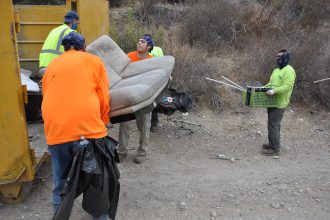
The dumpster arrived like an unlikely guest at dawn — a hulking, orange-backed silhouette against the low, pink smog of a Silver Lake morning. It landed with a metallic exhale, hydraulic hissing and the faint smell of diesel, and for a moment the world narrowed to the scrape of metal on asphalt and the neighbor’s dog barking at the new, square stranger.
The Morning the Alley Changed
Maria stood on the cracked concrete of her grandmother’s bungalow porch, fingers pressed to the rail as if she could steady the memory that had been held inside the house for generations. The bungalow had been quiet since Abuela moved to assisted living in Pasadena; now the walls were sliced open by sunlight and the promise of renovation. Across the alley, a longboard leaned against a fence; down the block, a mural of a sun smiled over a taco truck. A city if full lives carried on: joggers in Echo Park, a mechanic already coaxing an engine in Boyle Heights, coffee steaming on a porch in Highland Park.
Tom, the contractor, wiped grease from his palms and flashed a grin that was both apologetic and practical. ‘This thing’s big enough to swallow a storeroom,’ he said, pushing his hard hat back. ‘We cleared it with the city, but you know Los Angeles — the block will have opinions before noon.’ Maria laughed, but her stomach tightened. What would she throw away? What would have to stay? The clang of the dumpster lid was punctuated by the city waking up, and the project became less about wood and drywall and more about memory, logistics, and a tangle of municipal rules.
A City of Shortcuts and Red Tape
Imagine scheduling a guest in a city made of neighborhoods that both want to help and require a permit for every curbside inch. In Los Angeles — whether you’re in Santa Monica, Culver City, Burbank, Downtown LA, or further out in Long Beach — a dumpster isn’t just rented, it’s choreographed. Streets can be narrow like Venetian alleys, or wide and fast like parts of Commerce, and each jurisdiction often has a different set of rules about leaving a roll-off on public property.
‘You need a permit if the dumpster sits on the street,’ Tom told Maria as he unfolded a city map on the hood of his truck. ‘LA’s Department of Transportation will want to know about it. Some neighborhoods — West Hollywood, Beverly Hills — are extra picky. If it’s in your driveway, it’s simpler, but if you block parking or a fire lane, you’ll get a ticket and maybe worse.’ He pointed to a line of meters on Sunset Boulevard where the city-owned spaces could be held only with a permit. ‘And don’t forget the power lines. Those trucks need overhead clearance.’ The practical, granular advice cut through Maria’s anxiety: timing matters, as do the details.
Negotiations on Sunset Boulevard
By noon, the dumpster had become a neighborhood fixture. A woman from next door — a retired teacher named Joan from Echo Park — came over with two biscotti and a list of local donation spots. ‘If you’re getting rid of furniture, call Goodwill or Habitat for Humanity,’ she said, flipping through a notebook. ‘Don’t toss everything. There’s a man who collects scrap copper off Melrose. He’ll take metal and give you a few bucks.’ A teen on a skateboard paused, eyeing a pile of old books and a beaten record player with the reverence of someone who remembers analog textures.
These on-the-ground exchanges are the kind of solutions that city websites don’t always show. Maria found herself bargaining with sentiment: a chipped radio, the heavy dining table that had fed generations, a stack of bills to be shredded. Tom coached her on what dumpsters are best for what jobs. ‘You can get a 10-yard for a small cleanout, a 20-yard for a kitchen demo, or a 30-yard if you’re gutting a room or two,’ he said. ‘Weight matters too — concrete and tile eat up the weight allowance faster than wood. And if you’re in Santa Monica or West LA, watch for green waste rules.’ Between Silver Lake and Huntington Park, the advice shifted: in LA, recycling and composting regulations could affect what goes in the bin.
The Art and Science of Dumpster Removal
As the week unfolded, the dumpster became a makeshift archive. Old toys, a child’s drawing of the Griffith Observatory, decades of tax documents tied with a red ribbon — Maria sifted through history with gloved hands. The soundscape was never the same: the rumble of a Metro bus two blocks away, the siren that always seems distant in LA but never absent, the call of a street vendor. Each item she lifted carried a smell, a color, a memory — cigarette smoke on a yellowed program, the lemony antiseptic of old medicine bottles.
Tom taught her how to maximize the rental: stack flat materials, break down furniture, separate metals, and bag soft goods to compress them. ‘Lighten the load and you’ll avoid overage charges,’ he said. ‘Ask about the drop-off and pick-up schedule. And make sure there’s a tarp when it rains — water makes weight and drama.’ He also explained the environmental side: construction debris must often be separated because recycling facilities and landfills have different tipping fees. Some companies offer demolition debris hauling with sorting on site; others will drop a mixed-load dumpster that saves time but increases disposal costs.
When the City Shows Up
Midweek, a city inspector from the Public Works office stopped by. She inspected the placement, checked the permit pinned to the telephone pole, and measured the clearance to a fire hydrant three houses down. ‘You can’t block the hydrant or the driveway, and you have to post a copy of your permit in plain view,’ she said, stroking a clipboard. ‘Also, if you have hazardous materials — paint, solvents, old batteries — those need to go to a Household Hazardous Waste center. LA Sanitation runs drop-off events, or you can book an appointment at one of their sites.’ Her tone was neither punitive nor friendly; it was procedural. The city is both machine and neighbor, and in LA you need to know the gears.
At dusk, Maria and Joan hauled a stack of books to the car for donation. ‘My mother used to come to this block when the movie theaters showed classics,’ Joan said, hands full. ‘You never got rid of things like that — you passed them on.’ The dumpster, for all its bluntness, had become a conduit. It was a visible commitment to change, a public act of moving on.
Unloading the Past
On the last day of the rental, the roll-off truck returned with a driver who moved with mechanical efficiency. The metal hinges of the dumpster sighed under the strain of being lifted and slid onto the chassis. Tom and Maria watched as it tipped, the contents shifting like a story being told backward. There was a neatness in the chaos: lumber stacked on top, boxes of photographs cushioned in a corner, an old lamp that had somehow survived every move.
‘You know,’ the driver said as he tightened straps and checked the load, ‘I’ve seen homes all over LA. There’s always something that surprises you. Once I found a stack of letters sealed in wax in a Venice walk-up. People hang onto ghosts.’ He gave a half laugh, a sound softened by the skyline peeking between rooftops — a slice of downtown glinting in the distance, palms outlined against the sky.
Tom handed Maria a receipt and a few practical pointers for next projects: document what goes in the dumpster if you’re unsure about disposal rules; take photos for the permit; and always call ahead if you think you’ll exceed weight limits. He reminded her that many dumpster companies offer same-day service in busy areas like Hollywood and Downtown but that traffic and loading restrictions sometimes make timing an art. ‘If you schedule around rush hour, you save everyone a headache,’ he said. ‘LA’s rhythm is a stubborn thing — learn it and you’ll move better with it.’
What to Remember
At the end of the story, Maria locked the bungalow door for the first time in years and stood on the sidewalk watching the truck merge into the flow of the city. The alley felt different — lighter in a practical way, and oddly heavier in memory. The renovation would be months, a mosaic of subcontractors, permits, and design choices. But the dumpster’s absence marked a kind of threshold: decisions had been made, the past had been curated, and the future had space.
If you’re planning a cleanup or a renovation in the Greater Los Angeles Area, here’s what Maria learned without reading a brochure: check local permitting rules for your city — LA, Santa Monica, Burbank, Pasadena, Long Beach and the smaller municipalities all have specifics; choose the right dumpster size for the job and be mindful of weight limits; separate recyclable materials and hazardous waste; consider donation options before discarding; schedule pick-ups to avoid rush hour; and document the dumpster placement and permit to avoid fines. And when possible, ask neighbors — the human suggestions you get on a porch often save both money and sentiment.
In the last light, Maria walked back into the bungalow and ran her hand along the banister where generations had left their palms. The house no longer felt like a weight pressing down on the neighborhood; it felt like a promise. Outside, a cyclist rode past, the sound of his bell slicing the evening air, and the city carried on — its garbage trucks and artisans, its late-night diners and early-hour bakers. The dumpster, a simple tool, had done its quiet work: it had given Maria space to decide what to keep, what to let go, and how to make room for what comes next. The alley was ordinary again, but now it held the space of possibility, emptied and ready like a stage.
She closed the door behind her and for a moment the house seemed to breathe with her — an inhale that smelled faintly of lemon cleaner and the ocean two hours away. Outside, a plane threaded the late sky, heading toward LAX, carrying travelers home or away. The city rustled and hummed; somewhere between Santa Monica and Downtown, choices were being made and things were moving. In Los Angeles, you don’t just remove junk — you create the conditions for the next part of the story.