By the time the sun lifted itself above the eucalyptus-lined ridge of Silver Lake, Maria’s driveway already looked like a map of every decision she’d made and undone in the last twenty years: a stack of kitchen tiles waiting for the backsplash that never arrived, a sagging bookshelf that had held a hundred novels and one amateur romance, a pile of drywall dust that glittered when the light hit it. “We need somewhere to put it all,” she said to Javier, squinting into the morning like someone trying to read the horizon. “And fast.”
Setup: Morning in a Neighborhood That Never Sleeps
The neighborhood smelled like coffee from the corner cafe, roasted and bright, and of cut grass from a nearby yard. Down the block a child laughed, chasing a dog that darted between succulents and mid-century hedges. Maria and Javier stood beside a low-slung roll-off dumpster, its steel sides warm to the touch. Across town, from Santa Monica to Torrance, dumpsters were tipped and filled that same morning—on construction sites, outside apartment complexes in Echo Park, behind a cinema in Hollywood doing a late-season refresh.
Javier had been driving these streets for fifteen years. He knew which alleys swallowed a truck and which curbs required a permit. “People think it’s just hauling a box,” he said, tying a glove, the leather creaking like an old door. “But every job has a story—old flooring that tells you who lived there, paint that reveals a different life. We move more than junk. We move memory.”
Rising Action: A Problem on Magnolia Avenue
What started as a straightforward renovation in Silver Lake quickly became a puzzle. The city required a street permit if the dumpster sat on public property. Maria had thought a driveway placement would be simple, but a cluster of mature jacarandas and a narrow driveway meant the dumpster would block the neighbor’s garage. She crunched numbers on her phone, squinted at the map Javier unfurled, and heard distant sirens from Echo Park mingle with gulls from the coast—an auditory patchwork of Greater Los Angeles.
“You’ll need to apply for a temporary street permit with the city if it goes curbside,” Javier said. “And in Santa Monica or West Hollywood, they’ll want to see the traffic control plan. If there’s a festival or a Dodgers game in Inglewood, you better believe finding a truck route gets fun.”
Maria’s brow knotted. “I didn’t budget for a permit. Or for multiple pickups if this fills faster than we think.”
“We’ll figure it out,” Javier said, and his voice had the steady calm of someone who’d rerouted an entire day because a festival had spilled its vendors into a planned truck lane. He called his dispatcher—two quick rings, a pause while someone checked the municipal calendar, and a solution: a mid-size 20-yard dumpster that fit partly in the driveway and partly on the permitted curb for a short window, with cones and reflective signs.
Key Insights Woven into the Story
As they worked, the practical lessons slipped into the conversation like tools being passed back and forth. Javier explained sizes and uses: 10-yard bins for small cleanouts in Glendale or Burbank, 20- to 30-yard containers for most residential remodels in Pasadena, and 40-yard roll-offs for major construction sites near the ports and industrial zones of Long Beach and Wilmington. “Measure your space first,” he said. “A dumpster that’s too big smells like wasted money. Too small, and you pay for extra trips.”
There are smells on the job too—fresh-cut pine, damp insulation, the metallic tang of old nails. Javier pointed out a box labeled “E-waste” that Maria had tucked away from an old TV. “Electronics, batteries, paint, and tires—those usually can’t go in the dumpster. Some items need special handling or drop-offs at recycling centers or hazardous waste events. LA County and cities like Culver City and Torrance hold public collection events. Don’t just toss it and hope; it’s bad for the environment and can lead to fines.”
He said, “If you’re in Malibu or along the coast, you also want to think about stormwater runoff—cover the dumpster during rainy season and never let debris wash down to the storm drains. The ocean doesn’t need our paint chips.”
Permit issues came up again when a neighbor from Pasadena wandered over with questions. “Do you guys recycle any of it?” she asked, smelling the coffee and sawdust. Javier smiled and tapped the side of the bin. “We sort what we can. Wood, metal, and concrete often get separated at transfer stations. Some places have C&D recycling facilities—concrete and asphalt can be crushed and reused. And donations—if the couch is still good, Habitat for Humanity ReStore or local charities may take it.”
Midday: Small Victories and Unexpected Challenges
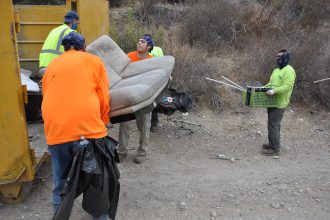
The driveway filled with a rhythm—lift, bend, scrape. The community joined in small ways: a neighbor from Hollywood dropped off a box of paint cans for proper disposal, a teenager from Glendale ran to fetch extra gloves when the stack of insulation started to itch. The dumpster was half-full by noon, the neighborhood soundtrack a hum of traffic, distant skateboard wheels on Sunset Boulevard, and a seagull calling from over the ocean.
Then a problem: a surprising weight spike. Maria had underestimated how dense old tile and concrete could be. The first pickup estimate was low; the scale at the transfer station would tell a different story. “We’ll likely hit a weight limit and have to factor overage fees,” Javier warned, shading his eyes. “Better to let the customer know now.” He called Maria over. “I hate surprises. If we’re honest now, we can split the cost of a second trip or pull a smaller load and get a third pickup later.”
Maria felt her stomach twist like the thought of extra expenses. Yet as she watched Javier negotiate over the phone—calm, pragmatic, human—she realized this was the same man who’d navigated his truck through a parade route last year and still delivered a dumpster on time. Trust, in this moment, was worth the incremental fee.
Resolution: Sunlight and an Empty Driveway
By late afternoon, the last piece of drywall slid into the dumpster with a satisfying thunk. The workers tapped the sides to settle the load; a breeze from the Pacific brushed the street and cooled the metal. The truck’s hydraulic arms rose and cradled the dumpster like a sleeping infant, then lifted it onto the bed. Neighbors waved; someone called out, “See you at the block party!” as the driver tipped his cap.
Maria stood in the doorway, feeling oddly light. The house felt bigger, less like a museum of postponed projects and more like a place that could breathe. Javier handed her a checklist: items to dispose of separately, numbers for local donation centers, and a reminder to check the city website for required permits next time. “Whatever you do,” he said, “don’t let the stuff tell you who you are. You decide that.”
Takeaway: What to Remember and Do
If you’re planning a cleanup or renovation in the Greater Los Angeles Area—whether in Santa Monica, Long Beach, Glendale, Burbank, Pasadena, Torrance, or Malibu—start by measuring your space and choosing the right dumpster size. Check local permit requirements: curbside placements often require permits in many cities. Know what you can’t toss: electronics, batteries, tires, hazardous liquids, and certain appliances need special handling or drop-off. Consider recycling and donation options first—Habitat stores, thrift shops, and community reuse programs can divert useful items from landfills.
Cost varies by size, weight, rental duration, and disposal location, and special event days or limited access zones (festival streets, game-day closures in Inglewood) can affect scheduling and routing. Communicate clearly with your hauler, plan for potential weight overages, and always ask about environmental practices: many companies separate recyclables and work with local transfer stations and recycling centers throughout LA County.
Final Image: A City Moving Forward
As the truck turned down the street and rejoined the flow of Los Angeles, the skyline shimmered with the gold light of late afternoon. Palm silhouettes edged the horizon, and somewhere between Hollywood and the harbor, another crew rolled out cones and set up a dumpster for a new job. Maria stood on her porch, the smell of sawdust now a memory, and watched the taillights fade into the urban tapestry. The house no longer held the weight of unfinished projects; it held potential. Nearby, the ocean sent a cool breath inland, and a gull—white against a bruise of sky—took wing, carrying nothing but the open air. That’s when she understood: getting rid of things isn’t always loss. Sometimes it’s the first step toward making room for the next story.