When Mia first opened the garage door in Highland Park, a summer gust sat like a memory in the air — dust motes floating through a shaft of light, the tang of old motor oil and lemon oil from a long-dried polish. She hadn’t expected the avalanche: boxes of yellowed sheet music, a rusted bicycle with a flat tire, a leaning tower of paint cans whose labels had long since faded. She’d called one company, then another, but what she needed wasn’t just a truck; it was someone who could navigate the city rules, the salty wind off Santa Monica, and the peculiar logistics of Los Angeles neighborhoods that change block to block.
Setup: The Decision to Let Go
Mia had moved to Echo Park ten years ago, drawn by the hills and the view of the downtown skyline, and she’d kept every piece of the life she was raised in. After her father’s passing, the garage was a time capsule of small tragedies and big comforts. She stood in the doorway, fingers brushing a dented toolbox, and realized she needed help to translate grief into space.
She called Tony, the voice on a recommendation from a friend in Silver Lake. ‘We do roll-offs and front-loads. Permits? No problem. We’ll handle the street placement if you need it,’ he said, and that first promise felt like air conditioning on a hot stretch of Sunset Boulevard. But as she scheduled a Thursday drop-off, a neighbor from down the block, Mr. Ramirez, warned her in his low Pasadena drawl, ‘Don’t block the street without a city permit, chica. Santa Monica, Beverly Hills — they bite.’ Mia promised to be careful. She didn’t yet know how many bites there are across the sprawling map of Greater Los Angeles.
Rising Action: Trucks, Permits, and the Smell of Paint
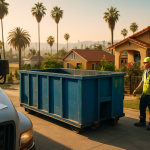
The morning the dumpster arrived, the neighborhood woke to the metallic song of a roll-off truck. Its engine vibrated through the concrete steps like a distant drumline. Rosa, the driver, hopped down in a neon vest, greeting Mia like they were old friends. ‘You ready?’ she asked, the smell of hot rubber and diesel clinging to her jacket. ‘We’ve got a 20-yard out back. Should be plenty unless you’re hiding a piano.’ They both laughed, which eased the tightness in Mia’s chest.
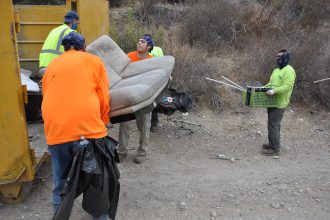
Loading began like choreography. Old guitars were propped against each other, sheet music slid out like fragile snow. Rosa and two crew members moved with practiced efficiency, but within an hour they hit the snag everyone warned about: a cluster of oil-soaked rags and half-empty paint cans discovered at the bottom of a box. ‘Those are hazardous,’ Rosa said, holding a can whose lid gave a tired hiss. ‘We can’t put them in the roll-off. They need special handling.’
Mia felt the old leave her and panic climb in its place. ‘What do I do with them?’ she asked.
‘We’ll take them to a household hazardous waste drop-off,’ Rosa replied. ‘There’s one in Long Beach on Mondays and Saturdays. Or the city-run events in Burbank sometimes accept small batches. But you can’t dump them at a transfer station or leave them in the dumpster — it’s a fire risk.’ Her words were firm but practical, like a map that suddenly made sense.
Then came the knock at the street — Mr. Ramirez, face clouded. ‘You got a permit for that thing?’ he asked, remembering what he’d seen on the news about parking tickets in Westwood.
Mia had assumed Tony’s team would manage curb permits, but the complex geography of LA meant different rules in Santa Monica, Glendale, and Torrance. Tony had arranged for a temporary street occupancy permit for Echo Park, but that permit wouldn’t fly if the dumpster needed to sit on a bus lane in Inglewood or required a sidewalk closure in Pasadena. What seemed like a simple afternoon of clearing had split into a puzzle of cities and ordinances.
Key Insights Woven Through the Story
As the day unfurled, Mia learned — hands-on — the lessons anyone in the Greater Los Angeles Area ought to know about dumpster removal. Rosa explained them between lifting keyed boxes and moving bulky furniture with the salty breeze off Long Beach just reaching the hills.
- Choose the right dumpster size: ’20 yards’ Rosa said, ‘fits a kitchen remodel or a big cleanout — couches, cabinets. 10s and 15s are for smaller jobs. Don’t overpay for emptiness or overfill and get hit with overweight fees.’ She demonstrated by stacking cardboard flat and folding sofas to create more room.
- Know what you can’t toss: Hazardous materials — paints, solvents, asbestos, certain electronics — require special handling. Landfills and haulers have strict rules, and cities like Santa Monica and Beverly Hills enforce them rigorously.
- Permits matter: If the dumpster blocks a parking lane, sidewalk, or affects bus routes — as in downtown LA or near Dodger Stadium during a game — you’ll need a permit. Permit rules differ from Glendale to Long Beach to Anaheim, so confirm with your hauler and local city hall.
- Recycling and donation: ‘We separate metals and reusable items,’ Rosa said, lifting a gleaming metal lamp. ‘In the Valley we donate to the thrift stores in Burbank, in Long Beach we recycle construction debris.’ Think sorting ahead to save money and give items a second life.
- Weight and materials: Concrete and dirt are heavy. Even a small pile can blow past weight limits and incur fees, particularly in beach-adjacent cities where trucks must travel farther to transfer stations.
- Scheduling and traffic: Los Angeles traffic is its own ecosystem. Early morning drops can avoid the freeways’ worst snarls and keep costs down; weekend pickups may be cheaper in residential areas but can conflict with local events or farmers markets.
Rosa’s advice was practical and specific. ‘Call before you fill,’ she said, ‘and take a photo for quotes. Tell them about concrete, tell them about dirt, and tell them about paint. If they hesitate, find another company.’ It was advice Mia would tuck into the back of her mind like a business card.
Emotional Threads: Memories, Stories, and Small Salvations
Between loading, Mia found herself pulling items that seemed to have stories stitched to them. An accordion with a cracked bellows reminded her of a childhood fair in Burbank. ‘Keep that,’ she said, surprising herself as she handed it to a neighbor who’d learned to play in the church choir. ‘My dad would like someone to play it.’ The neighbor’s laugh — raw and grateful — felt like a small benediction.
They also found a stack of city permits from the 1980s, faded stamps for work done in Pasadena. Each paper was a fingerprint of a previous life — renovations during summers, paint choices that were once trendy and now looked like relics. The crew respected the privacy of the old boxes, lifting only what was necessary and laying items on tarps with care.
Resolution: A Cleaner Space and a Seamless Exit
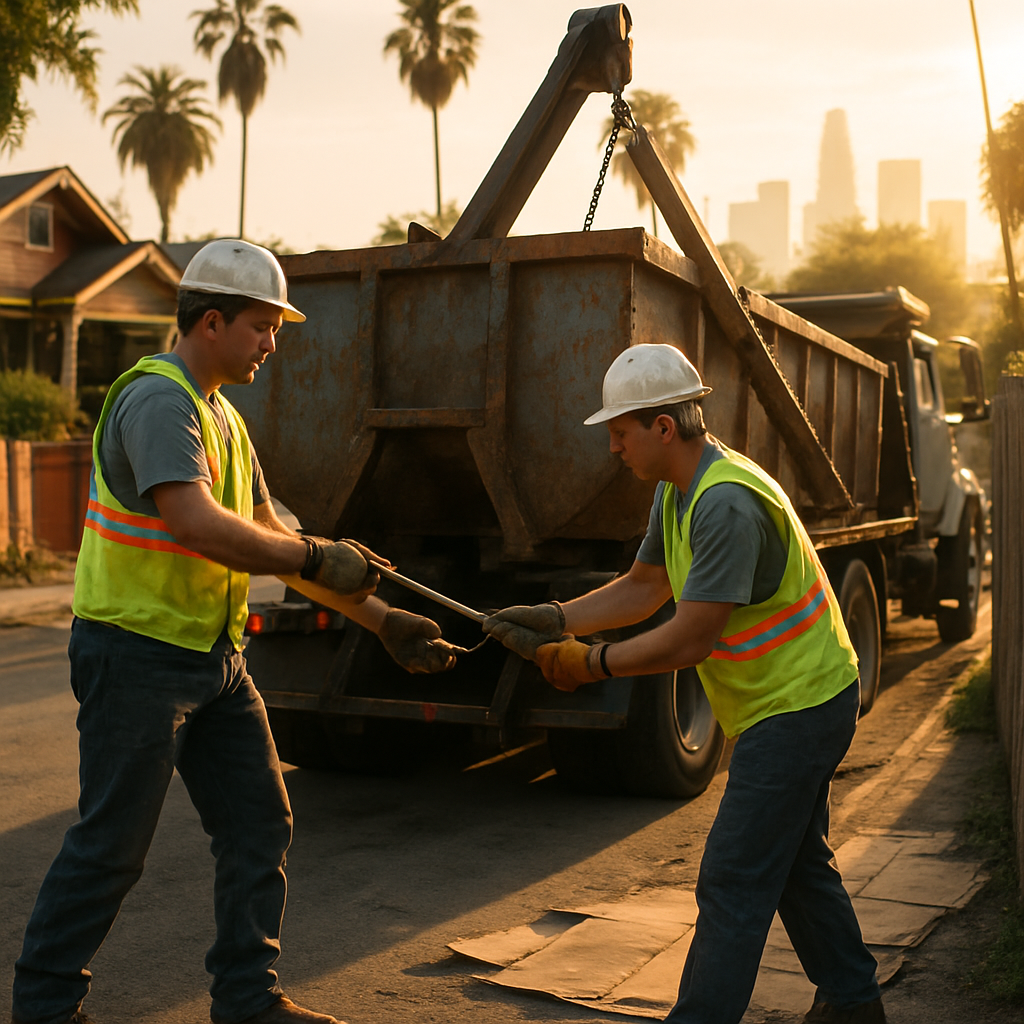
By late afternoon, the dumpster’s mouth had closed on the last of the clutter. Rosa signaled the crew, climbed back into the cab, and with a practiced reverence slid the dumpster onto the truck bed. The hiss of hydraulic lifts was a kind of punctuation. As the truck rolled away, Mia stood in the empty garage under a lowering sky, the city hum of Echo Park becoming a distant guitar riff.
There were small victories: a lamp donated to a thrift in North Hollywood, metal pieces taken to a recycling center in Downtown LA, and the hazardous paint cans safely scheduled for a household hazardous waste event in Long Beach. Tony had managed the permit for the curb placement, and Mr. Ramirez waved as if to say the neighborhood was passable again.
The emotional weight lifted in a way that was almost audible — a soft exhale that matched the neighborhood’s evening. Mia went inside and brewed coffee, the smell bright and familiar. She sat on the kitchen step and looked down the block, where the setting sun lit palm trees into silhouettes and the distant skyline glowed like a stage set. Her father’s toolbox sat cleaner now; the clutter was out, the memories still intact, cataloged, and freed from the physical pile that had once kept them together.
Takeaway: What to Remember and Do
Mia’s story is one you can feel in the soles of your shoes as you walk across LA’s diverse neighborhoods. If you’re facing a cleanout in the Greater Los Angeles Area, remember these practical and human-centered steps:
- Plan ahead: Pick the right dumpster size and schedule early to avoid peak traffic costs.
- Ask about permits: City rules vary between Santa Monica, Burbank, Pasadena, Torrance, and Long Beach — confirm curb placement and street occupancy details.
- Sort before you call: Separate recyclables, donations, and hazardous materials to save on fees and give items a second life.
- Choose a local, licensed hauler: Someone who knows LA’s neighborhoods can handle transfer stations and municipal requirements more smoothly.
- Communicate with neighbors: A quick conversation can prevent disputes and parking headaches on narrow residential streets from Silver Lake to Inglewood.
- Document and photograph: Help the hauler give an accurate quote and avoid surprises about weight and prohibited items.
When Mia locked the garage that evening, the echo of the day lingered: the metallic clang of the dumpster, the smell of gasoline, the soft gratitude of the neighbor who took an old accordion. The city around her exhaled with her — long boulevards, palm-lined avenues, the distant clang of the pier near Santa Monica twinkling like a lighthouse. In the end, it wasn’t just about making room for new furniture or a fresh coat of paint; it was about making room for life itself.
Rosa’s truck disappeared around the corner under a sky smeared with coral and lavender, leaving a gutter-scattered shadow and the clean geometry of an emptied garage. Mia stayed on the step, hands warm around her mug, and watched the last light bend over the hills. For the first time in a long while, she could breathe into the space her father had left and feel like the city itself was bearing witness — patient, pragmatic, and ready to hold whatever came next.