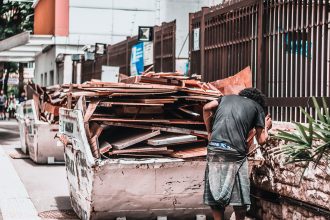
By the time the first truck rolled up, the street in Echo Park smelled of coffee and sawdust, and the sky over downtown Los Angeles was a watercolor of pink and smog. Maria stood on her front steps, sleeves rolled, cheeks dusted with drywall powder, and watched the roll-off dumpster clank against the asphalt like a creature settling into a new lair. She had imagined this moment a hundred times during late-night Pinterest scouting and frantic calls with contractors, but nothing had prepared her for the loud metallic breath of a machine that would hold a decade of her life.
Setup: The Project and the People
Maria’s house in Pasadena had been a hundred-year puzzle of layers: original hardwood under decades of linoleum, plaster walls hiding old wiring, and a backyard with a skeletal shed that once held a piano. Across the county line, Jamal, a foreman out of Burbank, rescheduled three jobs to be here by 7 a.m. He drove a truck with a California plate, a toolbox of stories, and a crew who knew every curve of the 101 and the secret back alleys of Hollywood where parking signs are a language of their own.
‘We call this the exhale stage,’ Jamal said, leaning on the dumpster’s rim as the crew slid in a battered couch. ‘You dump, you breathe, and then the house starts to look like yours again.’
It wasn’t just Maria and Jamal. The neighborhood was alive with the same understated urgency that marks renovation season across greater Los Angeles. Down the block in Silver Lake a homeowner was clearing out a lifetime of vintage magazines. In Santa Monica, a small ocean-view condo awaited a dumpster that would arrive on a tight curb permit window. In Long Beach, a contractor scheduled a weekend emptying to avoid weekday harbor traffic. These micro-dramas were stitched together by roads, regulations, and the hum of trucks finding curb cuts between palm trees and power lines.
Rising Action: Permit Confusion and Narrow Streets
Within an hour of delivery, a neighbor popped over, eyes curious. ‘Do you need a permit for that thing on the street?’ she asked, glancing at the yellow sticker Jamal had placed near the latch. Maria had thought she had everything sorted: dumpster size booked, contractor lined up, donations planned. What she hadn’t anticipated was the tangle of city rules that shift from one block to the next like traffic cones.
‘In Los Angeles proper, if it sits on the curb you need a permit from the city,’ Jamal explained. ‘Santa Monica wants their permits filed earlier if it’s along the beachfront during events. Pasadena and Glendale have their own rules about blocking sidewalks and HOA approval.’ He mimed holding a clipboard, and the neighbor laughed, oddly comforted by the bureaucratic choreography.
There were practical challenges, too. The street was narrow; a mischievous tip from Jamal kept the dumpster from scraping a neighbor’s car. A plywood sheet was slid under the unit to protect Maria’s driveway from the weight and the scuff of metal. Kids from a nearby school rode up on bikes, wide-eyed, as the crew tossed old furniture like confetti into the yawning mouth of the dumpster.
Key Insights Woven into the Story
As familiar items disappeared into metal, Jamal started explaining choices that most homeowners never see until they face a pile of unwanted things. ‘There are different sizes,’ he said. ‘Ten, fifteen, twenty, sometimes forty cubic yards. For a garage cleanout in Torrance, a small one does. For a full gut in West Hollywood, you might need something the size of a small room.’ He pointed at the stack of tiles and a bag of soil and continued, ‘And weight is the silent bill. Concrete, dirt, and tile are heavy. They can double your cost if you go over the weight limit.’
The crew sorted intuitively. Old paint cans were set aside for the household hazardous waste drop-off run the city schedules. Electronics were placed near the edge, slated for a special recycling trip rather than landfill. Maria had salvaged a few good cabinets and called a local ReStore and a community arts program in Glendale to take them. ‘It feels right to give it another life,’ she told Jamal, wiping sweat from her brow as the sun inched higher.
The story here is also a map of regulations. If the dumpster would sit on public property or block a sidewalk in Los Angeles, a permit from the city is often required. Enforcement varies: Hollywood and Westwood have strict street use policies, while out in Inglewood or Torrance the process may be faster but still requires notice. Homeowners renting dumpsters in Malibu or Santa Monica must also consider event calendars — a surf contest can mean stricter control over curb use and noise.
There are also environmental rules woven into the job. Asbestos, large quantities of fluorescent lights, batteries, solvents, and certain oils are off-limits. LA County runs household hazardous waste programs to safely handle these items. ‘Think of a dumpster like a selective memory,’ Jamal said. ‘It holds what you want to forget, but some things need special exits.’ He handed Maria a laminated list of prohibited items she could tuck into her drawer and consult like a map.
Middleground: Neighborhood Flair and Logistics
By midday the street had a rhythm. A neighbor returned a borrowed ladder and left behind a bag of old towels for dust control. Farther down the block, a crew in Burbank lifted a door with the care of a surgeon, because in this city doors have a way of becoming doors elsewhere — repurposed in a Hollywood prop house or reborn as a headboard in Eagle Rock.
‘Timing is everything,’ Jamal said. ‘If you want to avoid the 405 at 5, schedule a morning pickup. If you’re on a beachfront street in Santa Monica, aim for the early permit window. If you’re in Long Beach and working near the port, give an extra day for traffic and security checks.’ Each piece of advice was a small, local secret — a tactical map for moving heavy things through a city that moves at its own lyrical pace.
Climax: A Setback and a Quick Fix
At 3 p.m. a delivery in Venice had tied up one of the loaders the company had planned to use for Maria’s pickup. Jamal’s phone buzzed; for a moment his smile faded. The finishing crew was due tomorrow, and the rental period was set to expire. Maria felt that familiar prickle in her chest: the fear that permits, contractors, and timelines might collapse like scaffolding under a gust of wind.
‘We improvise,’ Jamal said, and it sounded like a promise. He called a partner company in Torrance, rerouted another truck from Anaheim, and negotiated an extension with the rental office he had on speed dial. He joked, ‘In LA, you need a GPS, a planner, and a pacifier for the city when it throws tantrums.’ Maria laughed; the tension loosened like a taped seam.
Resolution: The Last Load
The final load was almost ceremonial. Jamal and the team had decorated the interior of the dumpster with the last of the family photographs, carefully wrapped and set aside for choosing later. ‘We never throw family photographs without asking,’ he said. It felt less like policy and more like respect. When the lift truck hoisted the metal maw and backed toward the county line, the neighborhood watched like it was a passing parade.
At the transfer station later that evening, Maria and Jamal watched as the day’s material was weighed, logged, and separated. Some wood was diverted for recycling, metals were stripped out for salvage, and electronic waste was tucked into a separate bin. The machine’s roar had a finality to it, a punctuation mark on months of dust and decision. Maria exhaled, the way someone does after finishing a long book, when the last page sits heavy with meaning.
Takeaway: What to Remember
Everything about dumpster removal has an unsung choreography: the right size, the city’s permit whisperings, the simple arithmetic of weight, the moral choice to donate or recycle rather than toss. If you are in Los Angeles, Pasadena, Santa Monica, Long Beach, Glendale, Burbank, Hollywood, Venice, Inglewood, Malibu, Westwood, or Torrance, remember these points:
- Measure twice, reserve once: Choose the right size dumpster for the job, and plan a day longer than you think you need.
- Check local rules: Permit requirements vary across cities and neighborhoods; check with your city or your dumpster provider before your delivery day.
- Protect and plan: Lay plywood on driveways, reserve street space, and communicate with neighbors to avoid fines and friction.
- Sort and donate: Separate salvageable items for donation and recycling; Goodwill, Habitat ReStore, and local arts programs are eager for materials.
- Mind the weight: Heavy materials like concrete and soil can quickly raise costs because of weight overages at transfer stations.
- Dispose of hazardous materials properly: Paint, batteries, solvents, and electronics often require special handling through household hazardous waste programs.
By dusk the house in Pasadena looked like the slow reveal of a restored painting. The driveway was clean, the shed gone, and the air smelled faintly of sawdust and citrus from a neighbor’s tree. Maria held a salvaged cabinet door in her hands, its grain catching the last light. ‘Thank you,’ she said to Jamal, because gratitude felt like the only currency large enough to repay sweat, time, and the kindness of a crew that treated trash with tenderness.
Jamal waved as the truck pulled away toward the glitter of freeway lights and city signs. In the rearview mirror, the house stood quiet and whole, its noises and memories inside, not piled on the curb anymore. The city around them — from the cliffs of Malibu to the piers of Santa Monica, from the hills of Burbank to the palm-lined streets of Long Beach — continued to pulse with projects, each dumpster a small, honest footnote in someone else’s reinvention.
At twilight, Maria sat on the stoop and watched the sunset fade behind the silhouette of downtown. The street smelled of cooling asphalt and distant ocean spray. Somewhere a couple in Echo Park opened a box of flooring and decided to dance. In that moment the dumpster felt less like an ending and more like a space cleared for a new kind of living — one in which old things took different paths, and a community of drivers, contractors, donors, and neighbors helped carry the load. The last image is Maria turning the salvaged cabinet over in her hands, the wood catching fire-orange from the fading sun, a small, solid promise of what comes next.