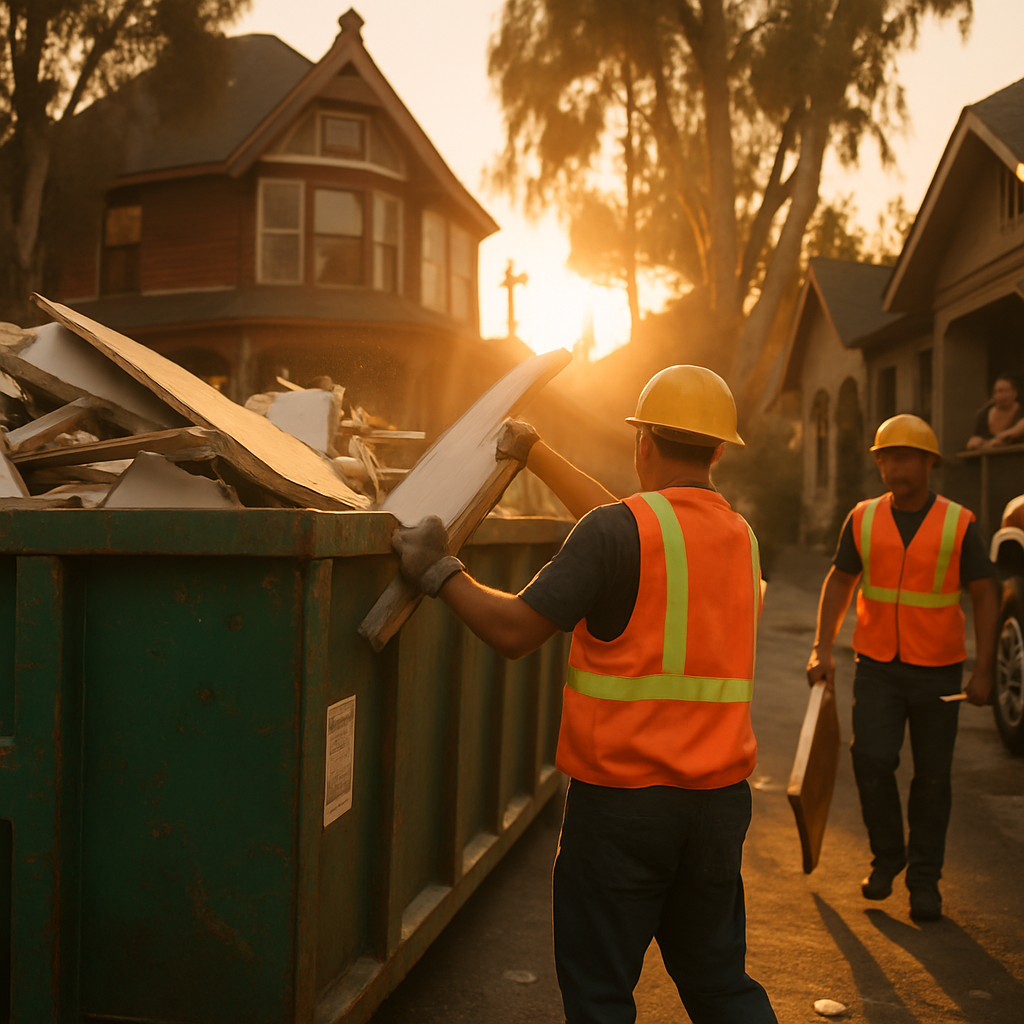
The first time Maria noticed the alley behind her Victorian in Echo Park had become a museum of broken chairs, carpet rolls and a refrigerator with a dented door, she thought someone was filming a prop sale. By sundown the pile had grown, breathing dust into the hot air, and the street smelled faintly of old paint and summer sweat. It was the kind of sight that makes you squint against the sun and realize your neighborhood is a living thing: messy, loud, and stubbornly in need of a cleanup.
Morning That Started with a Leak
It began, as many big projects do, with a small disaster. ‘The upstairs bathroom ceiling gave up,’ Maria told Jamal over coffee, her fingers tracing the rim of a chipped mug. ‘Water everywhere. We tore out the drywall and then decided to finally gut the whole thing.’
Maria’s house in Echo Park sat halfway between the hum of Sunset Boulevard and the quiet push of the hills. Her neighbor across the alley, Mrs. Alvarez from Silver Lake, watched from her back porch as contractors carried out buckets of waterlogged insulation and warped floorboards. They all agreed one thing: the debris would not fit in the curbside bins.
‘You need a dumpster,’ Jamal said, the way people who do demolition say things as though they are inevitable. He was a contractor from Culver City with a polite laugh and a veteran’s patience for city permitting paperwork. ‘Call a company, pick the size, get the permit if it’s on the street. Simple.’ Yet in a city that runs on permits, the word ‘simple’ tastes like something you should check twice.
Choosing the Right Container
The first call was to a hauling company in Burbank. The voice on the other end was brisk. ‘What’s the job? How long? Any concrete or tires? Do you need a street permit in Los Angeles or Santa Monica?’ Maria fumbled with terms she didn’t know: roll-off, tonnage, overage fees. Jamal translated as they stood in the alley watching the pile grow: ‘A 20-yard for a bathroom gut, maybe a 30 if you throw in some cabinets. If it sits on the street, you’ll likely need a permit from the city. Santa Monica and Beverly Hills enforce that pretty strictly.’ He tapped his phone and pulled up pictures of dumpsters in front of houses—metal rectangles with graffiti, doors flinging open like mouths.
‘And you can’t put hazardous stuff in there,’ the dispatcher reminded them. ‘No paint, no solvents, no fluorescent bulbs. We recycle as much as we can, but we can’t take everything.’ Maria pictured the old can of solvent in her garage and made a mental note to call a hazardous-waste drop-off.
When the Neighbors Notice
By noon, a green dumpster the size of a small car sat idling in the alley. The engine made a low, diesel frown that sounded like a truck clearing its throat. Mrs. Alvarez crossed over with a pitcher of ice water. ‘Looks like you guys are getting things handled,’ she said, peering into the container at the ragged stack of drywall.
‘We are trying,’ Maria said. ‘But I didn’t realize the permit would take a day.’
‘Some of those signs and cones are strict down in Santa Monica,’ Jamal said. ‘And in Long Beach they watch for concrete and asphalt—those go to different facilities.’ He named places as if they were landmarks on a map: Long Beach for big cleanups near the port, Torrance for heavy materials, Pasadena for construction permits, Glendale where narrow streets mean timed pickups. The list made the problem feel broader than their alley: a network of rules and transfer stations and recycling centers stretching across a city of neighborhoods.
Rising Tension: Rules, Smells, and Schedules
As the afternoon sun warmed the metal lip of the dumpster, the alley filled with a metallic scent, the smell of hot nails and old wood. Kids from down the block kicked a soccer ball against the fence. A delivery driver complaining about parking backed up traffic on the cross-street. Someone left a note taped to the dumpster’s side: ‘Please cover—bugs.’
‘We have to finish fast,’ Jamal muttered. ‘Storage tubs, more trips to the transfer station. If the dumpster sits more than a week you pay another day’s rental, and if it’s on the street without a permit the city will ticket you.’ Maria’s stomach tightened. A ticket could add hundreds to the bill. Her sister in Burbank had warned her about fines; a friend in West Hollywood had once had a dumpster towed when it blocked a curb cut. Every anecdote was a cautionary tale.
Key Insights in the Middle of the Mess
Working amid the thud and scrape, Jamal taught Maria lessons that felt practical and strangely tender: how to estimate volumes by stacking, why separating materials saves money, and when to call a specialty hauler.
‘Divide and conquer,’ he said, lifting a damp roll of insulation. ‘Keep wood separate from drywall and metals. Take paints and solvents to a hazardous waste collection—cities like Los Angeles and Pasadena have scheduled drop-offs. For concrete and asphalt call a construction-only service; it costs more but it avoids a surcharge at the transfer station.’ He pointed at the pile and then at a nearby recycling bin. ‘Metal goes for cash in some yards, believe it or not.’ Maria imagined coins clinking into a palm like a reward for sorting.
They talked sizes. 10-yard hauls are neat for garage cleanouts in Beverly Hills or Culver City when drivers need to navigate tight streets. A 20-yard is the workhorse for most residential remodels in Silver Lake and Echo Park. For whole-house renovations in Pasadena or Long Beach, 30- and 40-yard containers are the steady giants. And timing mattered: pickups before morning traffic in downtown Los Angeles avoided delays; weekend deliveries to Venice required watching for block parties.
Local Rules and the Importance of Permits
One afternoon Maria dialed the city’s sanitation department. ‘Some cities require a street use permit if the dumpster sits on public property,’ the clerk explained. ‘You’ll need to post the permit on the dumpster so parking enforcement can see it. Hours, location, and signage depend on the neighborhood.’ Jamal nodded. ‘Los Angeles enforces in certain districts,’ he said. ‘Santa Monica and Beverly Hills have their routines. In areas like Hollywood or West Hollywood you’ll see specific rules about loading times.’ These nuances made Maria feel as if each city had its own dialect of waste policy.
Cost was layered: the dumpster rental, hauling fees, weight overages, and sometimes the permit or the cone placement that the hauler arranged for an extra charge. ‘Ask the hauler if they include transfer station fees,’ Jamal advised. ‘Also ask where the load goes—some facilities have better recycling streams than others.’
Working Around People and Place
At one point, a neighbor from Sunset Junction complained about noise. Another neighbor left cookies on the stoop in sympathy. A teenager leaned over the fence, fascinated by a cracked mirror and the way light fractured across broken tiles. The project became less about hauling and more about choreography: timing pickups between school runs, placing cones not to anger a neighbor unloading groceries, and making sure the dumpster door didn’t swing into the alley’s narrow path.
‘We try to be mindful,’ the hauler, Luis, told Maria on day two. ‘This is people’s home. We drop, we pick, we don’t make a mess. If a homeowner wants to save money, sorts the load, removes recyclables, maybe even harvests metal—it helps everyone.’ His voice had the calm of someone who’d driven through rush hour and seen it all: the private dramas of home repair, the kindnesses and small gripes of neighborhoods from Inglewood to Torrance.
Resolution: The Last Load
Two weeks later the last sheet of drywall disappeared with an echoing clunk. The dumpster rattled away, metal on metal, like an end-of-act drum. For a moment the alley was quiet enough to hear the afternoon breeze through eucalyptus. Mrs. Alvarez leaned over the fence with a lemon bar wrapped in wax paper. ‘It feels like a new beginning,’ she said.
Maria counted the receipts, checked the invoices, and reflected on what she’d learned: a mid-sized dumpster and careful sorting saved her more money than she expected; scheduling pickups off-peak avoided surcharge time; and a permit that took a day saved her from a ticket that could have doubled her fees. She also found unexpected community in the chaos—a borrowed ladder from someone in Glendale, a kid who helped carry tiles to the curb, and the hauler who returned a lost set of keys he found rolled in a carpet.
Takeaway: What to Remember
If you’re facing a cleanup in Los Angeles, Santa Monica, Long Beach, Pasadena, or any of the cities that stitch the region together, think like Maria: estimate the job, ask about sizes and weight limits, separate materials, and check local rules. Know that hazardous materials have special handling, that some neighborhoods require street permits, and that timing your delivery can save you money and neighborly friction. Most importantly, choose a hauler who communicates clearly and respects the rhythms of your block.
As the sun slipped behind the hills, painting the alleys gold and the palm silhouettes long, Maria stood on her stoop and watched the last truck turn down the block. The house smelled faintly of sawdust and lemon from the bar Mrs. Alvarez had left. The neighborhood had been reshaped—not just by the removal of debris but by the small acts that made the job possible: the shared water pitcher, the insistence on sorting recyclables, the patience with paperwork.
When the dust finally settled, what remained was a clear alley and a clearer sense of how a city cleans itself: one dumpster, one permit, one considerate hauler, and a neighborhood that remembers how to be neighborly. The metal door had closed on the dumpster, but in the back of Maria’s mind, there was the image that would stay with her forever—a low, sturdy truck cutting across the sunset of Los Angeles, carrying away what was broken and leaving behind room to build again.