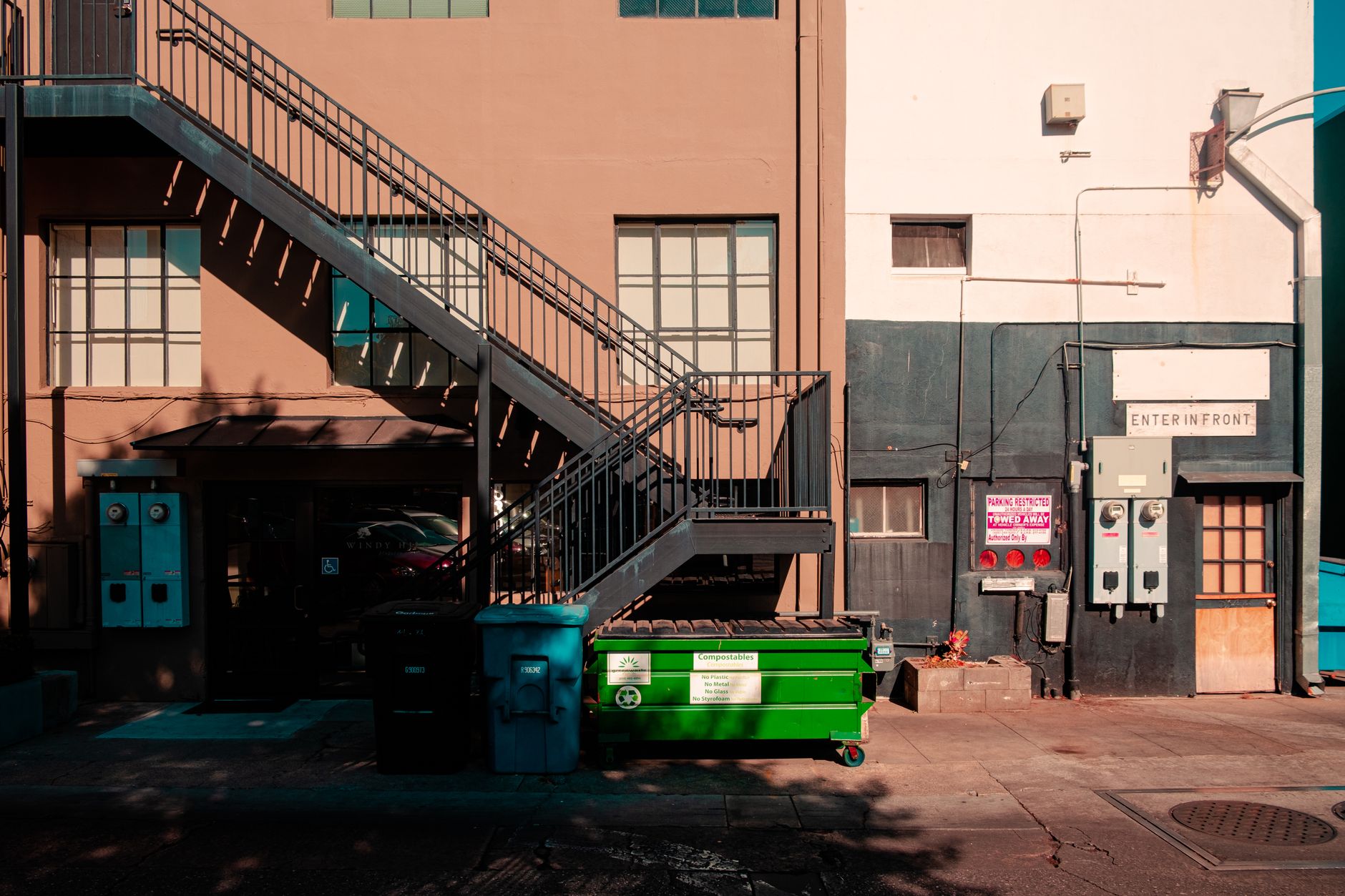
The knock on the door came before dawn, a hollow metal staccato that sounded like a cymbal crash against sleep. Maria opened her apartment in Eagle Rock to find a hulking green rectangle parked under the jacaranda tree, its metal sides sweating in the cool morning air. It smelled faintly of sawdust and old coffee. For a moment she just stood there and laughed — the sight was equal parts absurd and thrilling: a dumpster in her driveway, the start of something big.
Setup: Plans, People, and the Patchwork of Los Angeles
Two weeks earlier, when Maria and her contractor, Luis, first talked about tearing out the kitchen, their plan lived on a napkin and in Luis’s steady reassurance. ‘We’ll need a dumpster,’ he said, as if the word were as simple as a pencil line. Then the paper plans got eaten by conversations with neighbors, and the simple word swelled into a stack of questions: Which size do we need? Can we put it in the street in Echo Park? Will our HOA in Westchester freak out? What about permits in the City of Los Angeles, or if a neighbor called the cops?
Maria is not alone. From the rows of bungalows in Beverly Grove to the bungalow courts of Pasadena and the brightly painted houses of Venice, Angelenos remodel constantly: expanding kitchens, ripping out carpets, restoring historic front porches in Highland Park. Dumpsters have become as common as the berm of bougainvillea on a Sunset Boulevard fence. But in L.A., where every curb has its own story and every streetlight a municipal contact, putting a dumpster on the street is a small civic drama.
Rising Action: The Neighborhood Reacts
When Javier backed his truck down Maria’s street, the neighborhood woke up. A barista leaned out a Sunset strip window, hand wrapped around a paper cup. Mrs. Rojas from two doors down appeared with a folding chair, peering at the registration sticker on the dumpster’s side as if she were examining a guest list. ‘Do you have a permit?’ she asked sharply, hands on her hips like a captain checking a manifest.
‘We do,’ Luis said, producing a laminated sheet from his clipboard. ‘LADOT approved curb placement for three days.’ The paper glittered in the sun. The simplest proof of legitimacy. That piece of paper smoothed the tension like oil on a squeaky hinge.
But legality only keeps some problems at bay. That afternoon a neighbor from across the street — an elderly man named Howard who’d lived in his Craftsman since the 70s — stomped over. ‘My daughter’s allergic to dust,’ he muttered, tapping his cane. ‘You can’t park that there all week.’
‘We only need it for four days,’ Luis explained. ‘We’ll tarp it at night, and we won’t overload it. There’s a permit for curb placement — the sticker’s on the windshield.’ He spoke softly, the way someone soaks tension in bread dough: careful and patient.
They compromised. Maria agreed to keep the walkway clear, to call a freighter to sweep the sidewalk after each pickup, and to take the heavier debris directly to a transfer station in Long Beach when needed, instead of letting it sit. Howard sighed, accepted a promise, and returned home. The dumpster stayed.
Key Insights Woven into the Story
As the demolition went on, Maria learned the practicalities the hard way — not from brochures, but from the scrape and rhythm of work. Here are the lessons she absorbed, stitched into the narrative of her renovation:
‘Pick the right size,’ Luis told her one dusty afternoon. ‘Ten-yard for small cleanouts, twenty for a kitchen or bathroom, thirty to forty for large remodels or roof debris.’ He pointed with a gloved finger at a faded chart pinned in the back of his truck. She imagined them like boxes at the dry cleaner: one size to fit a weekend, another to swallow a season.
‘Ask about weight limits,’ Javier added as he leaned on the dumpster’s rim. ‘Most rentals include a set tonnage. Exceed it, and you’ll pay an overage. Heavy stuff like concrete, dirt, or tile bumps the scale fast.’ The warning mattered when Maria’s husband suggested keeping the old cement countertop bases for future garden beds. ‘Not a good idea,’ she said, thinking of surprise fees.
Permits factor into the drama in Los Angeles more than in many places. If you’re placing a dumpster on public property in the City of Los Angeles, you’ll usually need a street or curb permit from LADOT. ‘Each city has its own rules,’ Luis said when they talked about neighboring towns. ‘Santa Monica wants their own public works permit; West Hollywood can close a street for a block event, and Beverly Hills has strict aesthetic codes for appearance and signage.’ Even Pasadena and Glendale, wrapped in historic districts and careful preservation rules, sometimes require additional paperwork.
‘Know what’s allowed,’ Maria wrote on a sticky note and stuck it to her fridge. Hazardous materials — paint cans with wet paint, chemicals, fluorescent bulbs, and asbestos-containing materials — can’t be tossed in a standard roll-off. Appliances with refrigerants need special handling. Tires, batteries, and large quantities of soil often come with restrictions or extra fees. ‘Call the company and ask before you toss,’ Luis said. ‘It saves you headaches and fines.’
There were environmental pieces tucked into the story, too. California has strong recycling and disposal standards, and many companies in Greater Los Angeles will sort concrete and metal for recycling at transfer stations in Long Beach or the Puente Hills area. Maria watched as metal brackets and pipes were separated out and set aside for recycling, a tiny, silent victory.
Another thread in the narrative was timing. In neighborhoods like Downtown Los Angeles and Inglewood where traffic and street access are unpredictable, scheduling delivery before rush hour or on a weekend can save time. Santa Monica and Venice — with their tight streets and constant foot traffic — often require smaller roll-offs or driveway placement. ‘Think of logistics like a scene in a play,’ Javier said, his hands painting invisible stage directions. ‘Where the dumpster sits matters for deliveries, pedestrian flow, and neighbor patience.’
Small Moments: Human Details and Decisions
Maria’s son wandered by one day, dust in his hair, and asked, ‘Can we keep a ramp so the dog can get in and out?’ It was the sort of practical question that made everyone smile. They built a small plywood ramp and laid down rubber mats at the dumpster’s lip, mindful of squeaky neighbors and the city inspector who might take pictures.
One evening, a delivery driver from a neighboring building, who’d been watching the procession of work for days, stopped and said, ‘You know, when we tore up our roof in Burbank we had to get a special roofing permit and haul it straight to a certified facility.’ He told them about a roofing company in Torrance that handled shingles responsibly. The late-night exchange could have been small talk, but it felt like passing along a map.
Resolution: The Last Load
The final morning felt ceremonial. The crew moved like a small orchestra clearing its stage. Planks scraped, a last sofa groaned down a stairwell, and to Maria’s surprise, a cloud of rosemary and lemon peel drifted out of a box that had once been full of spices. ‘Who knew we’d throw that away?’ she said, holding the box like a relic.
Javier checked the permit once more. ‘All clear,’ he said, as if summing up a minor victory. The straps were tightened, and the truck pulled up. The dumpster was lifted like a stage prop and carried away, leaving behind a driveway that smelled faintly of sawdust, citrus, and newly installed wood varnish. The neighbors emerged to watch it go. Howard tipped his hat. Mrs. Rojas waved. Someone unslung a guitar and played a few chords on the porch; a small, warm sound to mark the end of work.
Later, Maria stood with a cup of coffee and looked at the small, freshly cleaned patch of sidewalk. The project had taken longer than she expected. It cost more than she hoped. But the kitchen had a new yellow tile backsplash that caught the afternoon light like a compliment. The dumpster had been an unruly guest that taught her a new fluency in municipal language and neighbor diplomacy. It had been a tool of transformation.
Takeaway: Practical Memories for Future Projects
Maria’s story captures the messy, human side of dumpster removal in Greater Los Angeles. If you are facing a similar scene, here are the essentials she learned the way most Angelenos learn best: through experience and conversation.
– Choose the right size: 10-40 yard roll-offs are common; match size to project scope. Smaller units work for cleanouts; larger ones for whole-house demos or roofs.
– Check permits: The City of Los Angeles requires curb/parking permits for public placement; other cities like Santa Monica, Beverly Hills, Pasadena, Glendale, Long Beach, and West Hollywood have their own rules.
– Know prohibited items: Hazardous waste, wet paint, batteries, certain appliances, and asbestos require special handling.
– Ask about weight limits and fees: Most rentals include a tonnage; overages and transfer station fees can add up.
– Plan logistics: Consider driveway placement, street width (especially in Venice or Hancock Park), HOA rules, and timing around rush hours.
– Recycle when possible: Metals, concrete, and wood can often be recycled; responsible companies will sort materials and direct them to local transfer stations.
– Communicate with neighbors: A little advance conversation and simple gestures — tarp at night, sidewalk sweeping, compacting trash — smooths a lot of friction.
As the sun slid down behind the hills, Maria walked the newly refreshed kitchen and paused at the window. Down below, the street was ordinary again: a mailbox, a parked bicycle, the small green patch where a dumpster had been. It feels easy now to imagine the next project, knowing what she knows. The dumpster was gone, but its lesson remained like a faint chalk line: measure, permit, communicate, and if possible, recycle.
The smell of citrus lingered, the sound of a distant guitar unfolded into the evening, and somewhere beyond the city lights, the harbor glinted like a promise. Maria set her coffee down and watched the last light warm the new tiles. ‘Ready for the next chapter?’ Luis asked, the way people ask when a house becomes a home again.
‘Yes,’ she said, smiling. ‘But next time we’ll start with the permit.’ The final image held — sunlight on tile, the faint ghost of a dumpster’s shadow, and a neighborhood that had learned to bend around change, together.