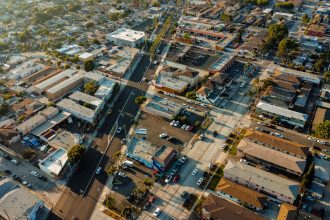
The dumpster arrived like a new neighbor at dawn, a steel mouth yawning onto the cracked asphalt of our Silver Lake street as the sky leaned pink over the Hollywood Hills. Mrs. Alvarez stood on the front steps with a battered tea mug in her hand, watching the tires crunch gravel, and for a moment the whole block held its breath—half grief, half relief—because this was more than a metal box; it was a promise to carry away thirty years of boxes, a couch that smelled faintly of cigarettes and summers, and a lifetime of that peculiar Los Angeles clutter that lives between the pages of people’s lives.
Setting the Scene
Los Angeles wakes up to a thousand small transformations every day: a storefront painted, a bungalow trimmed, a balcony cleared of broken chairs. From Santa Monica’s salty air to the industrial rhythm of Long Beach, from the tree-lined quiet of Pasadena to the tight alleys of Burbank and Glendale, dumpster removal is the low, practical choreography beneath the city’s larger reinventions. On our street the truck smelled of diesel and citrus gum, the driver wore a neon vest and a grin that had seen more attics than he cared to count. I introduced myself—Maria—and he said, ‘Call me Jamal. We’ve got a permit on the way. We’ll be quick.’ His voice was all business and rumor of kindness.
Rising Tension: The Problem Beneath the Junk
It starts innocently. A broken chair left on the porch in Culver City. An old piano that no one knows how to move in Hollywood. A homeowner in Torrance who decides to remodel and discovers, beneath old wallpaper, a century of lost receipts and faded photographs. In our case, the Alvarez family had found boxes of their late husband’s scripts, blue pages annotated in a handwriting that smelled of cigarette ash and ambition. To let go felt like erasing him. To keep everything meant living in a house that would slowly stop functioning.
‘We don’t want to throw it all away,’ Mrs. Alvarez told Jamal, her voice small. ‘Not those scripts.’ Jamal nodded and peered into the boxes like someone flipping through other people’s letters: ‘We can separate donations. We recycle what we can. Hazardous stuff goes to a different place. But you’ll have to decide.’
Decision is heavy in cities like ours where every object carries a memory and every alley has a story. Complications added up: the city of Los Angeles requires permits for most curbside roll-offs on public streets; in Santa Monica coastal rules complicate pickups near the pier; in Pasadena and Glendale historical districts insist on specific container placements; and in Inglewood or Long Beach narrow driveways and strict HOA rules can mean moving items and placing the dumpster in unusual spots. Each rule is a line on a map of bureaucracy that can quickly tangle a homeowner who just wants a clean house.
Learning the Ropes: Dumpster Sizes, Permits, and the Real Costs
As Jamal and his partner Maria—no relation—measured the driveway, he explained the anatomy of a roll-off: ‘Ten, fifteen, twenty, thirty yards. The smaller ones fit tight spots in West Hollywood. The thirty-yarders are for big demolition jobs in Anaheim and the harbor. But it’s not just the box size; it’s what you fill it with.’ They talked about weight limits like sailors talking about tides. Dirt, concrete, and tile add weight faster than wood or cardboard. Fill too much with heavy material and the bill jumps. Fill with mixed debris and sorting becomes a headache, but careful separation—electronics, mattresses, green waste, metal—often reduces cost and, importantly, sends less to distant landfills.
‘We always tell folks in Santa Monica and Malibu to set aside paints, solvents, batteries,’ Jamal said, pointing at a thin stack of aerosol cans on Mrs. Alvarez’s porch. ‘Those go to hazardous waste facilities. You don’t toss them in a dumpster and hope for the best. The county has drop-off days for that stuff.’
He showed us the permit form—no frills, an online application for curbside placement with a fee and a map stamped with the required cone placements. ‘It’s faster if you call your hauler first,’ Maria added. ‘Most of us handle the permit so people don’t have to sit on hold with the city for hours.’ That small kindness is often the difference between a weekend spent wrestling with forms and a weekend spent watching the city slowly unclutter your life.
Stories from the Streets
Across the Greater Los Angeles area, every dumpster sits in a story. In Long Beach, a contractor cleared out a former nightclub and found faded posters from the 1980s tucked behind insulation; in Burbank, a family renovating an old studio home discovered hand-painted set pieces that had been repurposed as drywall. In Glendale, a woman donated a mountain of children’s books to a local school after seeing a notice on the hauler’s van. In Inglewood, a neighborhood came together to split the cost of a large container to rid an abandoned lot of decades of dumped appliances and tires.
‘People think we just haul things away,’ Jamal said as he unfolded a roll of orange safety cones. ‘But we also become part of how a neighborhood remembers itself. We see what people keep and what they finally let go of.’ He paused, squinting at the sunrise. ‘Sometimes we find treasure. I once pulled out an old camera with a live roll of film in it near Hollywood. We tracked down the owner. They cried when we gave it back.’
Practical Steps and Key Insights
The Alvarez household became a small case study. We sorted: donate, recycle, hazardous, landfill. We called local organizations in Pasadena and Culver City that accepted gently used furniture and TVs; Long Beach and Torrance had specific days for bulky-item pickups if we chose not to pay for a dumpster. We learned that mattresses often have special disposal requirements, and electronic waste must be taken to certified e-waste centers. Jamal recommended a simple checklist: measure your driveway or curb space, estimate the volume of debris (a pickup truck equals about two to three cubic yards), check local permit rules, ask about weight limits, and ask the hauler whether they recycle or take items to transfer stations in LA, where material is sorted for salvage.
‘Ask for a breakdown,’ Maria told Mrs. Alvarez. ‘Price for wait time, for tonnage, for additional labor. Also ask what they do with donations. We work with a couple of shelters and thrift stores in the valley, and it makes a difference.’
Regulatory insight matters: in Los Angeles, a roll-off on a public street typically needs a Right-of-Way permit from the Department of Public Works; Santa Monica has coastal overlays that require additional review; and in certain historic districts a temporary container must be screened and placed carefully to avoid damage to old sidewalks or trees. Awareness prevents fines and late-night calls from neighbors.
Moments of Letting Go
By noon the dumpster was half full. The sound of metal clanging against steel punctuated the occasional laughter as Mrs. Alvarez and her daughter recited memories out loud—’Remember when Dad rehearsed on this couch?’—and then the small, private things: the smell of lemon cleaner, the cool drop of ocean on a Santa Monica evening, the honk of ships in Long Beach. Neighbors paused in lawns, wiped their hands, and offered bottles of water. A child from down the block asked if he could keep an old wooden magazine rack; Mrs. Alvarez said yes, smiling through tears.
‘It feels like a burial and a parade at the same time,’ she said. The metaphor stuck. The dumpster was a hearse and a float, carrying away the tangible past so that the house could breathe again.
Resolution: A Street Transformed
By late afternoon, the last debris slid in with a soft, final thud. Jamal tapped the back of the container, checked his checklist, and radioed the yard. The truck pulled away, its hydraulic groan folding into the traffic soundtrack that threads from Glendale to Hollywood. The street looked different—rooms felt lighter, photos on mantels suddenly seemed clearer without piles of boxes leaning against them. Mrs. Alvarez walked to the curb and watched the truck disappear, and I watched the sun angle down over the city and glaze the Hollywood sign in gold.
Neighbors drifted back into their homes with a sense of shared accomplishment. Someone across the street set out lemonade. The Alvarez family sat on their newly cleared couch and read aloud from an old script, the voice of the past finding a new audience, not boxed but living in the room, breathing with the present.
Takeaway: What to Remember
If you are in the Greater Los Angeles Area and facing a mountain of clutter or a renovation that requires a dumpster, remember these simple truths we learned that morning: measure twice, pick the right size, and plan for what you cannot legally dump—paints, batteries, electronics. Ask your hauler about permits and recycling practices. Consider donation partners in Santa Monica, Long Beach, Pasadena, and Burbank before consigning everything to the landfill. Be mindful of weight and materials: concrete weighs more than cardboard. Communicate with your neighbors, especially in narrow streets like those in West Hollywood or high-density blocks in Inglewood. Finally, see the process as more than disposal; it’s a kind of urban therapy, a way to let the city carry away what no longer serves you so new life can settle in.
When the dumpster is gone, what remains is always the human piece: stories reclaimed from boxes, the sound of children playing in a newly cleared yard, the smell of coffee from a neighbor stopping by to ask if you need help hauling a vintage lamp down the stairs. Los Angeles is a city built of reinvention, and dumpster removal is one of the quieter ways residents reshape their lives. As the light fell behind the hills, the empty space on Mrs. Alvarez’s porch felt like a breath taken after a long cry: small, steady, and ineffably hopeful.
The last image I carried home was of the truck’s taillights blinking through the palms on Sunset, a red punctuation moving west toward the ocean. For a moment the whole city felt tidy, as if someone had swept the streets with a giant broom, and the night promised that whatever remains to be let go will have its own dawn.