The dumpster arrived at dawn like a slow-moving black box, rumbling up Sunset Boulevard as the sky inched from indigo to bruise. Maya stood on her porch in Silver Lake, coffee cooling in her hand, listening to the hollow clanks as the driver wrestled the chain. “You sure you want this thing here?” her neighbor called from across the street, voice threaded with the morning’s skepticism. The dumpster smelled faintly of diesel and old paint; behind it, Hollywood’s billboard lights were still fading into memory. For the next week, this metal mouth would be the answer to a hundred decisions—what to keep, what to let go, how to manage the debris of a life and a house becoming something else.
Setup: A Remodel, a Deadline, and a Patchwork City
Maya had bought the bungalow for its light and its stubborn tiled fireplace, a detail she planned to preserve. She had not bought it for the half-collapse of a back room or the decades of accumulated junk lurking in the attic. She called three companies—one small family-run outfit in Inglewood, a mid-size business out of Long Beach, and a national service advertising same-day removal in Los Angeles. Each offered different prices, different timelines, different rules about what could go into the bin.
On the morning the dumpster arrived it felt like the city around her—an interconnected mess of rules and rhythms. Traffic on the 101 already thinned into a ribbon of honking commuters. In the distance, the Griffith Observatory capped the hills like a sentinel; a garbage truck thrummed through Echo Park. This was Greater Los Angeles: Santa Monica surfers, a film crew in Burbank, a school in Pasadena, warehouses in Torrance. Roles and regulations shifted from block to block.
Rising Action: Permits, Neighbors, and the Weight of Old Things
“You need a permit if you want it on the street,” Tony, the driver from Ramirez Hauling in Inglewood, said as he wiped his palms on his jeans. He had the blunt, patient tone of someone who had hauled other people’s chaos for years. “City of Los Angeles will ticket you if it’s in a no-parking zone or blocking a fire hydrant. Santa Monica? They ask about aesthetics. Pasadena? They ask about landscaping. Different cities, different questions.”
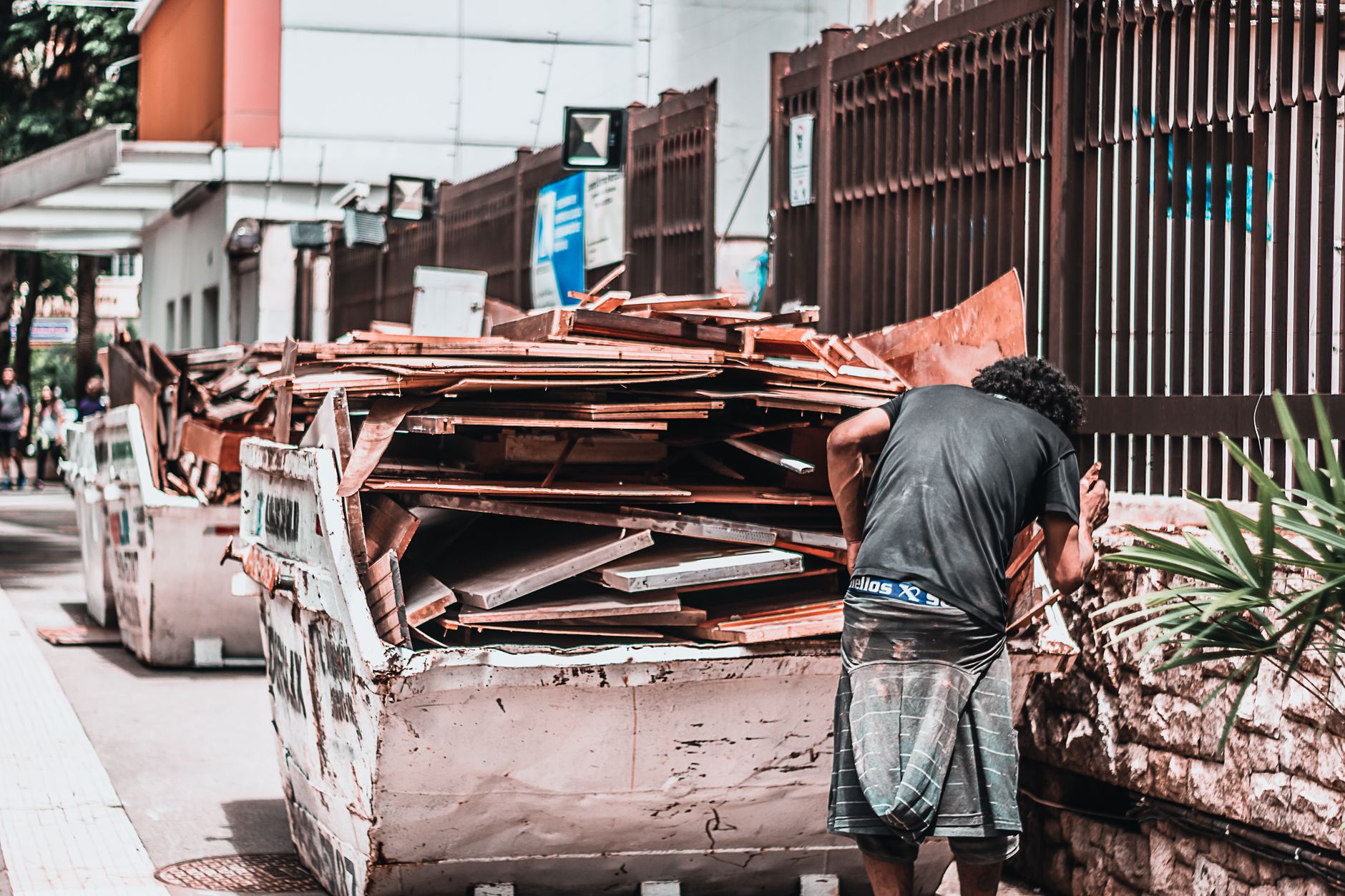
Maya felt the tension of one hundred small decisions tighten in her chest. She imagined an eight-hour stretch of metal and sunlight and the hand-lettered sticker on the side of the dumpster that read: 20 YD – MAX WEIGHT 3 TONS. “How big is that?” she asked. Tony pointed at the bin and then at a line of numbers on his tablet. “Ten, twenty, thirty, forty—roll-offs. For most home remodels, a 20 or 30-yard will do. If you’ve got demo, concrete, or dirt, you go heavier or split loads. Some places levy weight fees after a certain limit. In Torrance, a lot of contractors prefer multiple small bins because of narrow alleys and permit windows.”
Neighbors peered out as the first load went in. “You’re finally getting rid of that old sofa?” Mrs. Kline called from her kitchen in Echo Park. Inside the dumpster the sofa made a thud, the fabric exhaling decades of dust and a scent Maya recognized from Sunday afternoons. She hesitated before tossing in a box of framed photos. Tony had a rule: “If it’s sentimental, keep it. If you’re unsure, set it aside. We deal with stuff every day—people regret the things they throw away.”
Key Insights Woven into the Work
As the week unfolded, the story of the dumpster became a practical lesson in waste management across the LA basin. “Don’t mix hazardous materials,” Tony said one afternoon as they sorted through an old chemistry set and a paint-splattered can. “Batteries, tires, asbestos tiles—those are handled differently. Most cities, like Glendale and Burbank, require special disposal or licensed haulers for hazardous waste.” He pointed to a nest of cracked tile and explained the difference between construction debris and household refuse. “Concrete and dirt? Heavy. It’s cheaper to leave them out or get a dedicated concrete bin. Cardboard and wood? Recyclable or reusable in many cases. We try to divert as much as possible to recycling centers or donation centers in Long Beach or Anaheim.”
Maya learned about diversion rates and local transfer stations—how Puente Hills closed and reshaped the region’s disposal patterns, how transfer stations in Sun Valley and Carson became pivotal nodes. She listened as Tony described routes that curved like arteries across Greater LA: up through Glendale toward Pasadena when the 2 was clear, down the 110 to the ports on heavy haul days, along the 405 when it wasn’t a four-hour coffin of brake lights.
Cost breakdowns appeared in the story like signed receipts. Size mattered. Location mattered. Days mattered. Weight mattered. “If you need it on the street in Santa Monica or West Hollywood, you apply for a DOT permit and sometimes an encroachment permit,” Tony said. “If you’re on private property, you might not need one, but HOAs can say no. And there are restrictions during rush hour streets cleanings or farmer’s market days. It’s always good to call the city’s public works or check the municipality’s site.”
He also recommended donation options. “If it’s in good shape, ReStore—Habitat for Humanity in Long Beach—Salvation Army in Burbank. A lot of this can be repurposed. I dropped some vintage tiles at a shop in Pasadena the other day. They wanted them for a set design in Burbank.”
Scenes of Decision and Small Salvations
One afternoon, Maya and Tony stood over a pile of old kitchen cabinets. The sky was a bruised Venetian blue, and the smell of sawdust hung in the air like a memory. “We could take these to a donation center,” Maya said, pulling a warped drawer from the heap. A neighbor, Javier from across the alley in Culver City, passed by carrying boxes of hardware. “You should call that place in Long Beach,” he said, nodding toward a small logo on Tony’s truck. “They’re good for appliances still working. They’ll even pick up large items if you schedule.”
They found an old record player beneath a stack of insulation, its lacquer chipped but its needle intact. “You should keep that,” Tony said, smiling in a way that revealed why people trusted him. “I see little things like that, and I know they’ll mean more than the load fee.” Maya carried it into the house.
Not everything could be saved. There were piles of moldy drywall, bent rebar, and a bathtub that had weathered one too many storms. Each item had its destination dictated by law and logistics. “You can’t put a refrigerator in a regular bin without giving us a heads up,” Tony reminded her. “Some equipment needs to be handled to remove refrigerants. That’s state law. Inglewood follows the county’s hazardous guidelines.”
Resolution: The Last Haul and a City of Small Triumphs
On the final day, the sky over Santa Monica streaked with gulls and the golden hour cast everything in the mild glow of a promise kept. The dumpster was half-empty; the rest of the house had been transformed from a temporary battleground into a cleared stage. Crew members swept around the bin, and Tony checked his manifest. “We did a good job diverting material,” he said, tapping the tablet. “Some went to recycling, some to donation, the rest to the transfer station. Your weight stayed within range, so no overage fees.”
Mrs. Kline came out, clapped once, and then walked back inside with a bag of cookies and a handwritten note: thanks for keeping it tidy. The film crew down the block did a shot with the dumpster in the background—an accidental set dressing that will likely make an edit someday. From the porch, Maya could see the Pacific shimmering near Santa Monica Pier, a distant band of silver. For a week, a rumbling box had disrupted her street, but it had also facilitated the largest purge of things she no longer wanted. She felt lighter.
Takeaway: What to Remember and What to Do
By the time the truck hauled away the last sliver of debris, there were a handful of rules Maya had learned to live by. First: plan. Whether you’re in Hollywood, Burbank, or Torrance, call the city’s public works for curb placement rules and permit requirements. Second: sort early. Set aside hazardous materials, salvageable items, and recyclables—donate what you can to places in Long Beach, Pasadena, or Anaheim. Third: size matters. Estimate material by square footage of demolition or renovation—20-yard for medium remodels, 30 or 40 for larger demolitions. Fourth: know the prohibited items—learn which waste types require special handling and licensed haulers. Fifth: ask about weight limits and overage fees; heavy materials like concrete and dirt can balloon the final bill.
There are also human things to remember. Talk to your neighbors. Put a tarp under dust-prone work. Schedule drop-off outside of rush-hour street cleaning. And if you have a driver like Tony—someone who knows the city’s alleys and transfer stations—listen to him. He will tell you where to drop a sofa that still has life in it and where to send a rusted pipe that doesn’t.
As the last trace of diesel evaporated, the street looked smaller, more intimate. The banner of palm trees along the boulevard leaned in the evening breeze. Maya closed the door with the echo of tools still in the air and a record player tucked into a box of saved things. She could hear the faint clack of a film crew’s equipment miles away in Burbank, the distant gulls above Santa Monica, and a city that kept moving, hauling, donating, and reinventing itself one dumpster at a time.
The image that stayed with her was simple and bright: a metal rectangle rolling away down Sunset, disappearing into a seam of traffic, leaving space where there had been clutter, leaving a home that had begun to breathe again.