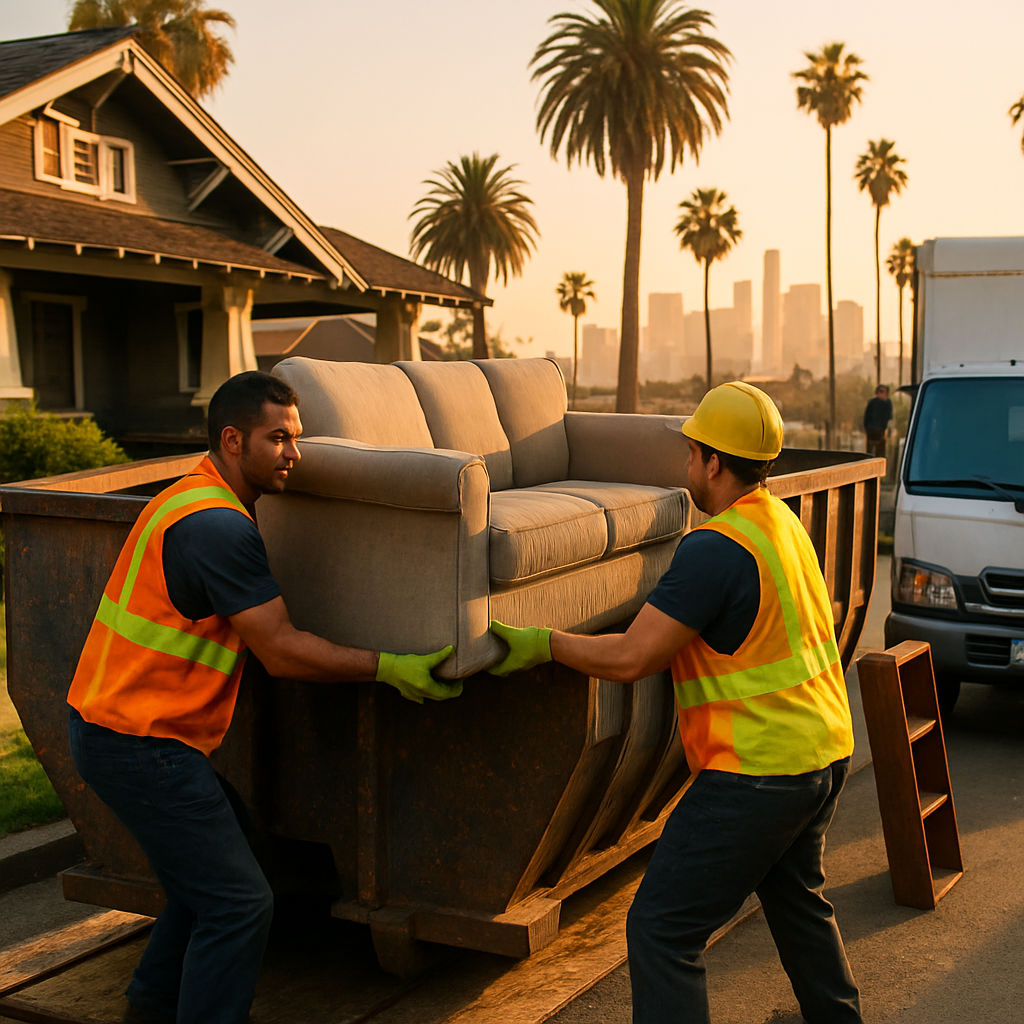
It started with a sofa that had seen too many movie nights. The fabric was threadbare, the springs complained when you sat, and a faint scent of popcorn clung to one corner like a stubborn memory. Maria dragged it out onto the driveway in Echo Park and stood back, squinting at the late afternoon sun as if the light could make the decision easier. Around her, the city hummed—street vendors calling, a distant siren, the clack of a skateboard on a nearby curb. She dialed a number she’d written on a flyer: roll-off dumpsters, fast service, permits handled. She didn’t know then that a single phone call would stitch her small act of purging into a larger story of neighborhood rhythms, municipal rules, and the surprising choreography of waste moving across the Greater Los Angeles landscape.
Setup: Characters, Places, and a Map of Needs
Maria is one of the many characters in this story. There’s also Tom, a contractor in Culver City who measures a backyard with the precision of a surgeon before ordering a 20-yard dumpster for a kitchen remodel. Luis, a driver from a small hauling company based in Torrance, has the hands of someone who’s hoisted steel frames and delicate vintage mirrors with equal care. Then there’s Mrs. Han from Pasadena, whose meticulous recycling habits have earned her the neighborhood’s grateful eye-rolls and a driveway full of sorted piles on every Saturday morning.
Across the map the scenes change: in Santa Monica the ocean wind carries the tang of salt and the quickening laughter of tourists, in Long Beach the harbor fog softens early mornings, and in Glendale the citrus trees fade into suburban lawns. Yet the need is the same: a place to temporarily hold the detritus of change—old carpet, broken furniture, demolition debris, boxes from a move, and, sometimes, the quietly illegal pile of paint cans someone swore they’d forget about.
“You’d be surprised,” Maria said to Luis when he arrived with a grease-streaked clipboard and a smile like a sunrise, “how many people don’t realize permits are a thing.” Luis laughed. “We get calls from Malibu and Inglewood the same week. Street placement, driveway placement, HOA drama—every project has its telenovela.”
Rising Action: The Hustle, the Rules, and the Stakes
What looks like a simple dumpster delivery is actually an orchestration of logistics and local ordinances. In Los Angeles proper, placing a roll-off container on the street often requires a permit from LADOT or the city’s public works, especially if the dumpster blocks parking or a lane. Santa Monica enforces stricter rules along its narrow residential streets and near the beachfront; construction projects there often need additional signage and protection for pedestrians and bike lanes. Long Beach and Torrance each have their own nuances about weight limits and disposal requirements. A wrong move—literally—can mean a citation, a fine, or a delayed project.
The day the dumpster arrived at Maria’s, a neighbor from across the alley, Jeff from Highland Park, leaned over the fence. “You getting rid of everything?” he asked. The breeze smelled faintly of jasmine and gasoline. Maria shrugged. “Stuff, mostly. A bit of guilt.” Jeff nodded. “Don’t forget the e-waste laws. My cousin works at a tech shop in Burbank—he says TVs and computers need special handling.”
That’s right: California takes certain things seriously. Electronics, batteries, and some appliances are bound by e-waste and hazardous waste laws. Paint, solvents, motor oil, and asbestos materials need special disposal and often cannot go into a standard roll-off. In cities like Pasadena and Glendale, contractors must show proof that hazardous materials are separated and disposed of at approved facilities. This isn’t just red tape; it’s protection for workers, waterways, and the landfill ecosystem.
On the street, Luis guided the truck into the driveway with practiced choreography. He placed wooden planks under the dumpster’s wheels to protect Maria’s pavers, a small act that reveals a lot about the business: attention to detail matters. The dumpster settled with a thud that vibrated the sugar jar on Maria’s kitchen counter. “Better to pay a little for protection than to discover a popped tile,” Luis said.
Key Insights: Practical Wisdom Hidden in a Story
As the crew began to load, conversation drifted between stories and tips. Tom, who’d seen many job sites, offered straightforward rules that read like a survival guide for anyone hiring a dumpster in the Greater Los Angeles Area:
• Choose the right size: Dumpster sizes typically range from 10 to 40 cubic yards. A 10-yard fits small cleanouts; a 20-yard suits medium renovations; 30 to 40 yards handle big demolition and construction projects. Measure access points—Los Angeles alleys and Malibu driveways can impose real constraints.n
• Check permits early: If the dumpster will sit on a public street or sidewalk in Los Angeles, Santa Monica, or Long Beach, apply for a permit days or weeks ahead. Some cities require traffic control plans or pedestrian protection.n
• Know weight limits and surcharges: Weight matters. Haulers often include a tonnage limit and charge for overages. Concrete and dirt are heavy—mixing them with lighter debris can push you into extra fees quickly.n
• Separate hazardous items: Paints, solvents, batteries, fluorescent tubes, and appliances need special handling; California has take-back programs and designated drop-off facilities. Ask your hauler or city recycling center before you toss.n
• Protect surfaces: Use boards or protective pads to prevent scratches or oil stains on driveways. In areas with HOA oversight, confirm rules about placement and duration.n
• Opt for local haulers when possible: Drivers familiar with Glendale, Inglewood, or Culver City know the quirks of each municipality—where permits are a headache, where landfill fees spike, and which transfer stations are quickest.
“We always tell customers about the little extra things,” Luis said, wiping sweat from his brow as the late sun angled low through eucalyptus. “Like when to schedule pickups to avoid rush-hour chaos on the 405, or which facilities in Long Beach accept mixed construction debris. Those small choices save time and money.”
He pointed across town toward a mental map of disposal facilities: Scholl Canyon for certain materials near Glendale, transfer stations that serve the south bay, and specialized recyclers in Long Beach that take concrete and metal. Maria listened, cataloging each tip like a list of ingredients for a new recipe—one for unburdening.
Resolution: Emptying Spaces, Making Room
By the end of the week, the dumpster had been a small stage for several acts. An elderly bookshelf from a Pasadena attic had been lifted out and, to everyone’s surprise, rescued by a neighbor who loved the curve of its carved feet. Old tiles were swept into piles and sorted for recycling; a piano that no longer played sat silent and sullen as it was hoisted into the metal maw before joining the chorus of other discarded items.
Maria stood on the porch as the truck rattled away, the city unfolding in layers—a skyline brushed by smog, the glittering promise of the ocean to the west, the slow climb of hills toward Glendale. The driveway was clean; the house felt like it had taken a breath. “It’s weird,” she said to Jeff, who’d come over with two iced coffees, “how a pile of junk can weigh as much as the things we carry inside.”
“That’s why we have dumpsters,” Tom said, leaning against the fence. “They’re containers for both things and decisions. You decide to let go.”
The logistical ballet that enabled Maria’s decision to stick—permits filed, the right size chosen, materials separated, surfaces protected—had smoothed the way. The crew’s knowledge of municipal quirks from Inglewood to Malibu, and their respect for local recycling mandates, turned an ordinary cleanup into a responsible civic act.
Takeaway: What to Remember and Do Next
If you’re standing where Maria stood—hand on an old sofa, wondering where change begins—remember a few simple things before you place that phone call:
• Plan early: Permits and scheduling take time, especially in busy neighborhoods like Santa Monica or along narrow streets in Hollywood and Culver City.n
• Ask smart questions: About size, placement, weight limits, prohibited items, and drop-off locations.n
• Choose a hauler who knows the area: Local knowledge saves hours and fees, and ensures compliance with city-specific rules.n
• Separate and protect: Keep hazardous materials out of standard dumpsters and protect driveways and sidewalks.n
• Consider reuse: Someone else’s junk might be a treasure for a neighbor or a nonprofit; salvage before disposal whenever possible.
As Luis waved goodbye and the truck’s rumble faded into a familiar LA soundtrack of distant traffic and dog barks, Maria closed the gate and inhaled. The air smelled faintly of citrus and oil from a passing truck, the sky a wide California blue. The house felt new not because the walls had been repainted but because the space inside had shifted—empty room where a memory once sat, a cleared path toward whatever comes next.
In the weeks that followed Maria would find herself less burdened by memories anchored to objects. She donated the salvaged bookshelf to a community center in Burbank, and a neighbor picked up old tiles to mosaic a backyard bench. The dumpster’s brief stay had rippled outward, moving items, money, and decisions across neighborhoods stretching from Venice to Torrance, from Inglewood to Malibu.
Sometimes progress is loud—the thud of a dumpster settling, the clang of metal hitting steel. Sometimes it’s quiet: a cup of coffee shared over a fence, the small satisfaction of an organized garage, the evening breeze that slips in when a heavy piece of the past has finally rolled away. The city keeps moving, one container at a time, and in the spaces left behind, people like Maria find room to breathe.
Night fell soft and forgiving, and the streetlights in Echo Park blinked awake like something private being shared with the sky. Maria stood for a moment at the doorway and watched the darkness gather neatly, like someone tucking a blanket around the neighborhood. The last image was a simple one: the driveway, spotless, a faint outline where the dumpster had rested, absorbing the day’s warmth and cooling into a promise. The past had been rolled away; now there was room for what came next.