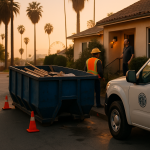
The dumpster arrived at dawn like a traveling character in a long-running Los Angeles play — a hulking rectangle of steel that smelled faintly of oil and yesterday’s rain, its sides warm where the sun had already begun tracing the skyline. Maria watched from her Pasadena front stoop as the driver, Javier, eased the truck into the street and set the hydraulic arm with practiced patience. ‘We’ll take what you’ve got, but let’s talk sizes first,’ he said, tapping the catalog of options on his tablet. It sounded simple enough until the neighbor across the street peered from behind his hedge and asked, ‘Do you have a permit for that?’ The question hung in the morning air like the gulls that haunt Santa Monica’s piers — small, persistent, impossible to ignore.
Setup: Who’s Involved and Why This Matters
Maria was three days into a kitchen gut job that had turned her 1920s bungalow into an archaeological dig: piles of tile dust, a leaning refrigerator that had been her grandmother’s, cabinets with the ghosts of old paint, and a bathtub she was determined to turn into a freestanding statement. Across town, in Burbank, a small film crew needed a roll-off to clear set debris before their location fee ticked upward; down the coast in Long Beach, a landlord dealt with a hoarder’s eviction and a backyard full of broken furniture. From Malibu stucco to the alleyways of Echo Park, dumpster removal threads through urban life in ways people rarely notice until something goes wrong.
Rising Action: Permits, Timing, and the Dance of Logistics
The first snag arrived as gently as a wrong-colored tile. In Pasadena, a curbside placement required a permit from the city if the dumpster took up parking, and Maria’s street backed into a small, congested block where every spot felt like prime real estate. Javier explained the choices: on-property placement whenever possible; curb placement when the driveway couldn’t hold a 20-yard; short-term permits for 1–7 days versus extended rentals for remodels. ‘We can keep it tight to minimize impact. But tell me your timeline,’ he said, tracing the skeleton of the plan with a fingertip on the tablet’s glass.
Down the line, another crew in Santa Monica contended with coastal winds that threatened to scatter loose insulation across Ocean Avenue, while a contractor in Torrance fought the summer heat as the dumpsters filled with the dense, sweaty weight of demolition debris. In Hollywood, the deadline was heartbreakingly cinematic: a set had to be clear by noon for a high-profile shoot. Inglewood’s residential streets raised the stakes when neighbors feared blocked views or parking disputes. Each issue introduced a new layer of negotiation, a small tension that could swell into a late fee or a citation if mishandled.
Key Insights: What the Dumpster Story Teaches Us
As blades of plywood and rusted nails settled into the metal trough, Javier and Maria’s conversation drifted into the practical: dumpster sizes, weight limits, prohibited items, and the surprising civic choreography that keeps Los Angeles running. ‘People think it’s just dropping a bin,’ Javier said, flipping the device to show a schematic. ‘But there’s a whole ecosystem — permits, transfer stations, recycling, and special handling for hazardous stuff.’ He pointed to the list and tapped the 10, 20, 30, 40-yard icons. ‘For a kitchen and partial demo, most homeowners in Glendale or Pasadena go with 15 to 20 yards. For full-house gut jobs in Beverly Hills, you’re usually looking at 30 yards or more.’
He also explained weight limits. ‘Most contracts include a tonnage allowance. If you go over, they charge per extra ton. Heavy materials like concrete or dirt can fill up the weight limit before you reach the physical capacity, so people often rent a smaller bin thinking they’ll save money and then rack up overages.’ The point landed with the quiet authority of someone who’d seen a thousand driveways cleared and a thousand people learn the same lesson the hard way.
Recycling and disposal practices in Greater Los Angeles vary by city but share a common aim: divert what can be diverted. ‘Metal, cardboard, clean wood—these usually go to materials recovery facilities. Green waste gets composted. Asbestos, paints, and electronics need special handling and can’t go in a regular roll-off,’ Javier warned. He named a few familiar transfer stations and recycling centers by neighborhood: the busier transfer hubs near downtown LA for construction waste, quieter municipal yards in San Pedro for yard debris, and specialty e-waste drop-offs scheduled through county programs. Maria scribbled notes in the margin of her contractor’s estimate, picturing piles of copper and drywall transforming from chaos to ordered loads routed to different places.
Scene: The Sensory Landscape of Waste and Renewal
The truck’s engine hummed like a distant tide as the city woke. In Santa Monica, the ocean air rode the wind and softened the sharp tang of paint stripper; in Glendale, the air smelled faintly of citrus from a neighbor’s tree. In Long Beach, the salt-saturated breeze rustled through palm fronds that cast long, lacy shadows across the open dumpster. Each placement came with a particular soundtrack: the clatter of tiles in one, the muted thud of drywall in another, the low murmur of pedestrians who paused to watch the ebb and flow of an urban chore that most people only notice in crisis.
‘It’s almost like a small theater in every neighborhood,’ said Mia, Maria’s contractor, as she brushed a strand of hair from her forehead. ‘We set up, perform the demolition, then we clear. People watch because it’s a visible change—sometimes it’s relief, other times it’s worry about what the day will bring.’ Their banter was punctuated by the metallic clang when a cast-off faucet made its last, dignified exit into the dumpster, and by the soft thud of insulation falling in werewolf-like piles that needed to be carefully bagged to avoid scattering.
Practical Steps Woven Into the Story
As the hours moved and the pile shrank into neat layers of recyclable wood and mixed debris, Javier walked Maria through a checklist that any homeowner or contractor could use: measure the driveway space to determine if on-property placement is possible; estimate the project volume to choose the right yardage; check local municipal websites or call city halls for curbside permit requirements in Los Angeles, Santa Monica, Long Beach, Pasadena, or Torrance; ask about weight limits and overage fees; and separate hazardous materials ahead of time. ‘Also,’ he added, tapping his temple with a knowing smile, ‘talk to your neighbors. A heads-up keeps people patient when you take the curb for a few days.’ Maria laughed, picturing a sticky note diplomacy campaign on her mailbox.
They also discussed timing: rentals usually run a week, but remodels can require longer. A staggered schedule — smaller dumpsters arriving as needed rather than one enormous bin — can be cost-effective in neighborhoods like Culver City or West Hollywood where space is tight. For businesses, choosing a service that offers evening or early-morning drops can avoid rush-hour congestion and keep operations fluid.
Conflict and Solution: When Things Don’t Go as Planned
Mid-afternoon brought the hiccup everyone feared. The neighbor’s complaint in Pasadena had turned into a voicemail from the city: the permit hadn’t been filed. Mia’s stomach dropped. The crew paused, the city’s humming traffic a distant drumbeat. ‘We can stay on the property,’ Javier said quickly, scanning for options. ‘I’ll call the company to sort the permit and we’ll politely move the bin to your driveway. It adds an hour, but it’s better than a fine.’ The solution felt small and human — a reminder that most problems in city living are logistical puzzles solvable with patience and local knowledge.
While the bin moved and the city official’s concerns were mollified with proof of an application in process, the crew kept working, layering debris and separating metals. In Hollywood, a film location manager called to confirm that their roll-off would be emptied overnight to make way for dawn lighting. ‘We’ll do it,’ Javier said. ‘Just give us the window.’ Coordination, as ever, was the name of the game.
Resolution: Clearing the Space, Finding the Calm
By late afternoon, Maria’s street had shed the construction chaos like a stage after the final applause. The dumpster, filled and lock-tagged for recycling separation, gleamed with a sheen of dust. Neighbors drifted back outside to inspect the change. ‘Looks great,’ her neighbor said, offering an olive branch of sorts, and Maria felt a surprising rush of pride — not just in a stripped-down kitchen, but in having navigated the municipal maze and neighborhood politics without a siren or a citation.
Javier climbed into his cab, wiping his hands on a rag that still carried the smell of motor oil and warm metal. ‘We’ll pick it up tomorrow morning, get it to the right facility, and file everything accurately,’ he told Maria. There was a calm competence to his words, a proof that routine expertise can make the difference between chaos and a job well-finished. As the truck pulled away, Maria stood in the doorway and watched the city flow: a bus on Colorado Boulevard, a jogger pushing through a hill in Pasadena, a distant plane carving a white line above downtown Los Angeles.
Takeaway: What to Remember and Do Next
If the tale of one dumpster across the Greater Los Angeles area teaches anything, it is that waste removal is more than a bin and a truck. It is a choreography of permits, local rules, hauling logistics, and human negotiation. Before you rent: measure your space, estimate volume, ask about weight and prohibited items, check permit requirements for your city — be it Los Angeles, Santa Monica, Long Beach, Pasadena, Glendale, Burbank, or Malibu — and communicate with neighbors. Choose a reputable company that separates recyclables and knows the local transfer stations. Plan for contingencies: storms, wind, neighbor disputes, and timing for film crews or HOA concerns can all affect the course.
As dusk settled, the empty lot where the dumpster had been felt like a small stadium cleared after a public performance: the audience dispersed, the instruments stowed, and the stage waiting for the next act. Maria inhaled the evening air, tasting the faint ocean tang that drifted down from Santa Monica even though she was miles inland. The kitchen would come next — cabinets, counters, the careful installation of a sink that would catch the morning light. For now, the space was clear, a hush where there had been clatter, and the city continued, patient and pragmatic, ready for the next job that would need a truck, a permit, and a team that understood how to turn debris back into order.
Outside, a single palm tree cut a long silhouette against a sky that smudged from gold to mauve. The dumpster was gone, but the lesson remained: in Los Angeles, every small clearing is part ritual, part regulation, and part neighborhood story — and when done right, it leaves room not just for renovation, but for a little bit of peace.