The day the old kitchen cabinets went out the door, Maya stood on the cracked concrete of her Echo Park driveway and felt the house breathe a little easier. A rusty roll-off dumpster sat like a metal open-mouthed beast in the late-morning sun, humming with the promise of order. Palm fronds whispered on the corner of Sunset Boulevard; a neighbor’s radio drifted soft salsa. This wasn’t glamorous—that’s what made it feel honest.
Setting the Scene: Why a Dumpster?
Maya had called it a refresh, but the reality was a year of delayed projects finally converging: a kitchen gut, the back fence replacing, and a garage cleared to make space for a long-delayed art studio. In Los Angeles—where homes are often squeezed between eucalyptus and curbside parking—one dumpster could become the pivot between chaos and progress. She had pictured a tidy pile of debris, not the mountain of drywall, old tile, and a mysterious box of ceramics she hadn’t seen since the move.
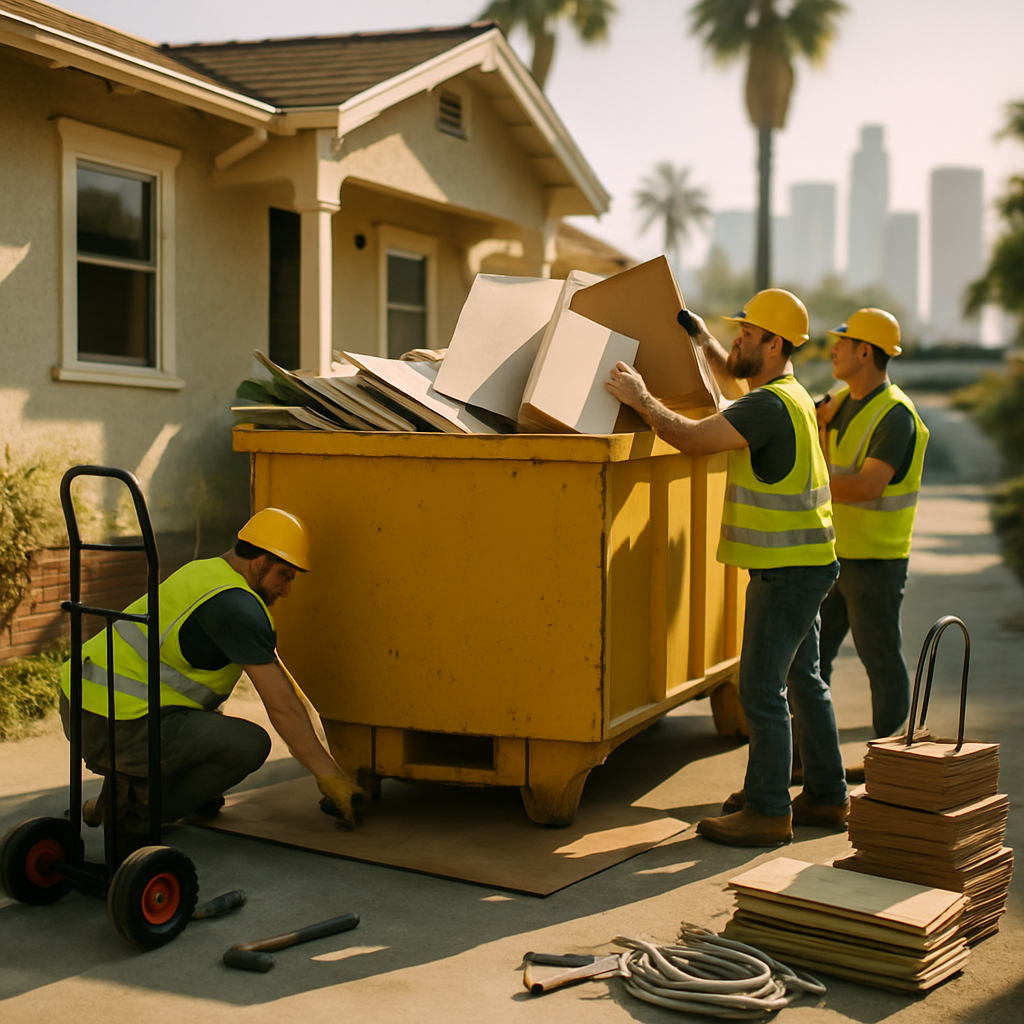
She remembered Ramon’s truck rolling up—big, low, and professional. Ramon, who drove for a small roll-off company based in the San Gabriel Valley, tapped the brakes and walked over with a clipboard and a quick, practical smile. “We’ll place it where it causes the least trouble,” he said, studying the driveway, the sloping curb, the parked Prius that seemed permanently lodged in the neighbor’s space. “But you’ll want to protect that driveway—let’s put down some wood.”
Rising Action: The Tension of Logistics
Even before Ramon had finished the first box, Maya had a growing list of questions: Could the dumpster sit on the street? Did she need a permit? How big should she have ordered? Her contractor, Sara, had warned that the wrong decision could cost more in fines and delays than in the dumpster rental itself.
“In Santa Monica,” Sara said, wiping dust on her jeans, “they’re very strict about curb placement and permits. In Beverly Hills, you’ll want a plan for aesthetics. But in many parts of Los Angeles, permits are manageable—just make sure you check with the city.” Her voice had that practical edge of someone who’d watched projects balloon and then shrink back down with one smart phone call.
Ramon nodded. “Most people go with a 20-yard for a home remodel, 10-15 for cleanouts, 30-40 for big construction. But it’s not just size—weight matters. Concrete and dirt eat up your tonnage fast. We’ll quote both dimensions and weight allowances. If you go over, there’s usually an overage fee.”
Key Insights: Choosing the Right Dumpster
Choosing the correct dumpster is an art informed by a little math. Ramon explained the common sizes: 10-yard (small remodels or cleanouts), 20-yard (typical for kitchens and small remodels), 30-yard and 40-yard (large construction or full-property cleanouts). “Think of it like ordering delivery pizza,” he joked. “You don’t want to order small and still be hungry.” He recommended measuring the project area and estimating bulky items—cabinets, tiles, doors—because those disproportionally consume volume.
Placement was a second strategic decision. In dense neighborhoods like Silver Lake and West Hollywood, there’s often no space to put a dumpster on a driveway without blocking access, which means curb placement becomes the default. Many Los Angeles neighborhoods require a street or parking permit for that. LADOT processes, or city-specific departments in places like Glendale or Pasadena, handle those permits. Permit fees vary, often a modest one-time charge ranging from under $50 to a few hundred dollars in some municipalities—check local regulations ahead of time.
Ramon also emphasized protective measures. “Lay down plywood or 3/4-inch boards if the dumpster sits on a driveway,” he said. “We don’t want to leave scuffs or gouges. If it’s on the street, make sure you mark it clearly. You’d be surprised how many kids on scooters come through in the afternoon.” He gestured toward a neighbor who had a skateboard deck, and Maya felt a wave of gratitude that someone thought ahead.
Key Insights: Costs, Timing, and Hidden Fees
Costs in the Greater Los Angeles Area vary widely. Maya had called three companies: one in Burbank, one in Inglewood, and another in Long Beach. Quotes ranged from a lower-speed $325 baseline for a 10-yard bin to upwards of $1,200 for a 40-yard with higher weight allowances. Most rentals include a standard 7- to 10-day period; extra days usually cost more. Overweight fees, special pickup requirements, and tipping fees at transfer stations are common add-ons.
Ramon explained the tipping fees like a local: “Transfer stations and landfills charge per ton. In LA County, that fluctuates and depends on the facility. Also, if we take you to a transfer station in Commerce or to an out-of-county landfill, the fees change.” His hands sketched invisible maps of routes, and Maya pictured the truck pulsing through morning traffic on the 5 and the 710, a mobile theater of debris.
Key Insights: Regulations and Recycling
Environmental rules are part of the calculus. Many Los Angeles cities and South Bay communities emphasize diversion—keeping reusable materials, metal, and clean wood out of landfills. Long Beach and Torrance, for example, have robust recycling programs and sometimes require documentation showing what percentage of collected material was diverted. Contractors often sort metals, schedule separate pickups for cardboard and drywall, or use local recycling yards to reclaim value.
Hazardous materials deserve a special note. Old paint cans, solvents, batteries, and electronics can’t go into a roll-off dumpster. Los Angeles County runs Household Hazardous Waste collection sites and periodic drop-off events. “We had a client in Culver City who put a pile of aerosol cans in a bin and got a stern phone call from the hauler,” Sara said. “It’s not just illegal—it’s dangerous.” Ramon added practical advice: label any suspicious canisters and segregate them for proper disposal.
Rising Action Continued: A Surprise Discovery
One afternoon, as the crew rolled an afternoon sprint of tiles toward the dumpster, Maya felt a hard clunk against her palm. She bent and found, half-buried in mortar, an old Polaroid of her grandmother—faded, sun-bleached at one corner. The image was of a woman in a wide-brimmed hat on a sunny day somewhere that looked nothing like LA but smelled of citrus and ocean at once in Maya’s memory.
“Don’t throw that away,” Ramon said softly when she held it up. The crew muttered, as if they understood that sometimes a project collects more than dust. Sara suggested scanning it and keeping both the scan and the original. It became a small ritual: before each bulky item went in, they checked for small treasures. It slowed the process in all the right ways.
Practical Tips Woven into the Story
As the days passed, the rhythm of loading settled into a practical choreography. Sara taught Maya to break down bulky items, to remove nails from lumber so wood could be recycled, and to flatten boxes. Ramon suggested heavier items go in first, evenly distributed to avoid tipping during transport. They learned to keep the dumpster below the top edge—overfilling is a big no, both for safety and for legal pickup requirements.
They also planned around Los Angeles’s traffic and weather. Early morning deliveries avoid rush-hour fines and make maneuvering big trucks in narrow streets easier. On hot days, they scheduled pickups during cooler morning hours to protect workers. “Heat matters,” Ramon said, wiping his forehead. “It’s less about the truck and more about the team doing the loading.”
Resolution: The Day It All Left
On the final morning, the truck’s engine hummed a low rumble. The crew had filled the dumpster in a neat, workmanlike fashion. Maya stood on the steps and watched as Ramon chained the bin and the lifting arms heaved it up. For a second, the dumpster hung in midair like a metal cliff, carrying with it a season of decisions, scrapped mistakes, and the little finds that made the work feel meaningful.
As the truck backed down the block and turned toward the 110, a neighbor called out, “Looking good!” Maya waved. The house looked different already—cleaner, like a deep breath after a run. She felt relief and a little sadness, the tug of endings that also make room for beginnings.
Takeaway: What to Remember and Do
If you’re planning a dumpster rental anywhere from Hollywood to Huntington Park, from Santa Monica to Long Beach, remember these practical points that turned Maya’s chaotic project into a manageable, even humane process:
– Pick a size that fits the job: 10-20 yards for cleanouts and small remodels; 30-40 yards for major construction. Ask your hauler about weight limits and overage fees.
– Check local permitting: many LA neighborhoods require curb permits for street placement. Each city—Burbank, Glendale, Pasadena, Inglewood—has its own rules.
– Protect surfaces: place plywood or boards under the dumpster on driveways to prevent damage.
– Separate hazardous materials and electronic waste: use county HHW events or scheduled pickups for paint, batteries, and e-waste.
– Recycle where you can: metals, clean wood, and drywall scraps may be reclaimed. Ask your hauler where they take materials and request diversion documentation if needed.
– Plan deliveries early: avoid traffic, protect crews from heat, and reduce disruption to neighbors.
– Get everything in writing: itemize costs, rental period, weight allowance, and pickup logistics. Verify company licensing and insurance.
Maya’s kitchen eventually came together: bright, with reclaimed wood shelves and a small space for a potted herb that thrived on the balcony. The dumpster had left a faint circle on the driveway and a clear space in the garage where the art studio would go. More than that, it left a story—the Polaroid tucked into a frame on a shelf in the new kitchen—proof that even in a city of perpetual reinvention, small histories persist.
When Ramon rolled his truck past a week later, Maya stood in the doorway with a coffee and shouted, “Thanks!” He tipped his cap, the city spread wide behind him: palm silhouettes, glimpses of distant hills, and the endless sweep of streets where other projects waited. The dumpster had been a chapter; the house, a next page. The echo of the day was not garbage and grit but a sense that sometimes you have to clear out the old to make space for the things that matter most.
Across Los Angeles, from the salt air of Venice to the quiet cul-de-sacs of Torrance, the story repeats—families, contractors, and haulers coordinating the small but consequential work of renovation. It’s messy, practical, and often surprisingly tender. And if you ever find a Polaroid in a box of tiles, you’ll know what to do: stop, breathe, and choose what to keep.