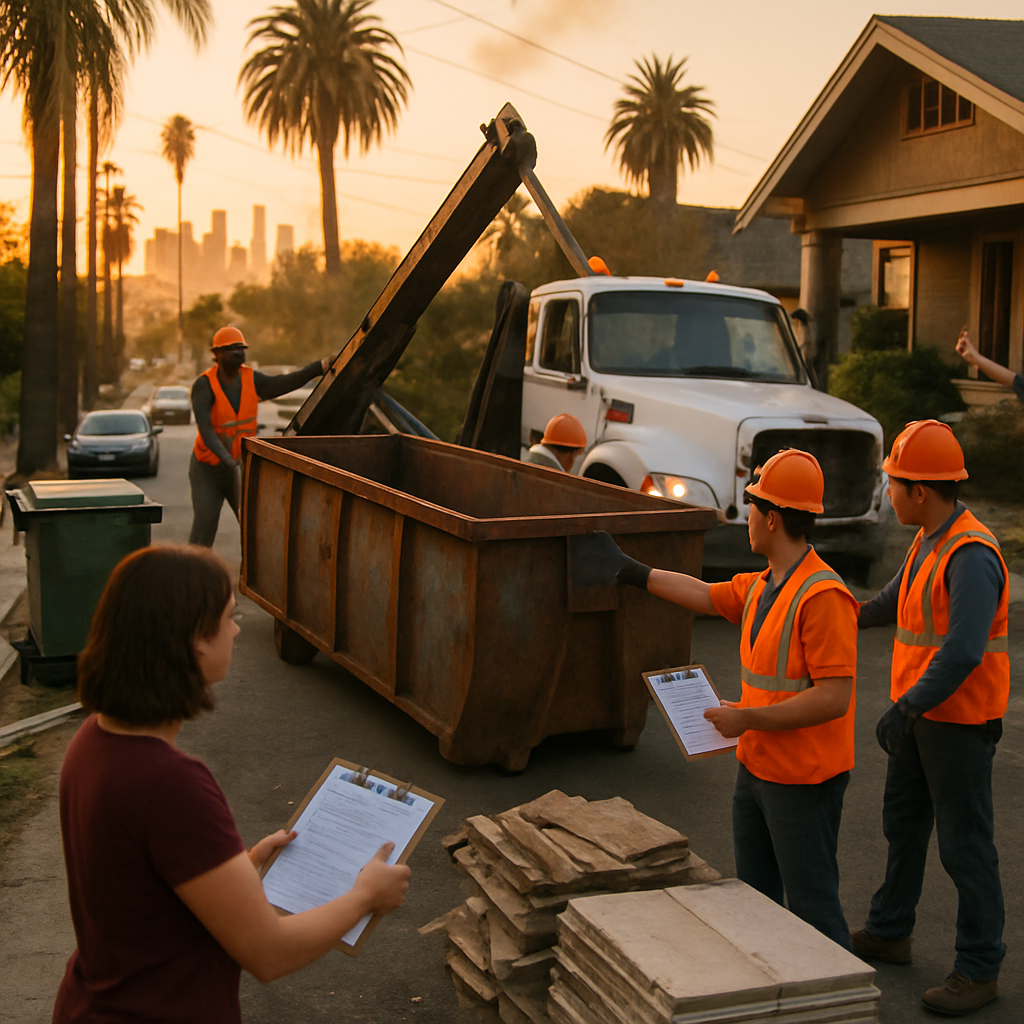
The first time Maria saw the dumpster arrive on Magnolia Avenue, the whole block smelled like diesel and eucalyptus, and the setting sun turned palm fronds into black fans against a bruised orange sky. A bored toddler on the porch dropped her ice cream; a dog three houses down began to bark as if the truck were an old enemy returning. For a moment the city felt both enormous and intimately small — a neighborhood compacted into one noisy, dusty rectangle of curb and asphalt.
The Problem That Began with a Leaky Roof
It had started, like many of these stories do in Southern California, with a leak. The old bungalow in Highland Park where Maria rented a room had a roof that gave way during last winter’s storm, and the drywall in the back bedroom started to crumble. She called a contractor, the contractor called for a crew, and before she knew it there were stacks of plaster, old furniture, and strange metal fittings filling her yard. “We can handle the demo in a day, but we’ll need a dumpster,” the foreman told her, scratching the back of his neck where the sun had reddened him.
Her first question was practical: where would they put it? Magnolia Avenue is one of those streets that narrows toward the middle, bordered by vintage cars and morning coffee drinkers. Some neighbors had driveways; others park on both sides, turning any large vehicle into a traffic puzzle. Others in Los Angeles know this choreography well — a parking permit here, a skinny driveway there, the constant negotiation with space that comes with living in a dense, sprawling city.
Neighbors, Nosy Observers, and a Permit Hanging in the Balance
By the next morning the roll-off truck arrived just after dawn, the crew in bright orange vests moving with that efficient, slightly theatrical hurry that only people used to heavy lifting possess. “We’ll need to set it on the curb,” the foreman said to Maria. “You’ll need a street permit if it stays there more than a couple days.” He glanced up the block. “And this is Highland Park — the city of Los Angeles will want to know.”
Across town, similar scenes were playing out with different flavors. In Santa Monica, a homeowner hauling out decades of beach-house hoarding had to worry about coastal regulations and resident complaints about noise; in Burbank a film studio’s set strike meant a larger, specialized container; in Long Beach a homeowner working on a kitchen remodel needed the dumpster to fit into a steep driveway and coordinate with a homeowner’s association. Each city in the Greater Los Angeles Area — Pasadena, Glendale, Torrance, Culver City, Inglewood, Beverly Hills, and even Malibu — has its own quirks and rules when it comes to placing a dumpster, and those differences can turn a simple rental into a logistical test.
Tension Builds: The Truck, the Permit, and the HOA
By midmorning on Magnolia, a conversation on the sidewalk grew louder. Mrs. Delaney from two houses down, famous on the block for her pointed stare and immaculate geraniums, wasn’t happy. “You can’t leave that there all week! It will ruin the curb appeal,” she said, folding her arms like a judge. The foreman smiled a practiced smile. “Ma’am, we’ll have the permit filed by noon. It just takes a few signatures. We’ll keep it tidy.”
In truth, obtaining a permit can take longer. In the City of Los Angeles, a permit from the Department of Transportation is often required to place a roll-off on a public street; other cities have their own public works or municipal codes. Costs vary — sometimes just a small administrative fee, sometimes $50 to $150, and sometimes more when residential or commercial zones require special handling. Private property usually avoids the permit conversation, but driveways and alleys present their own spatial and weight limitations. In San Fernando Valley neighborhoods, narrow alleys and overhead lines can interfere with the truck’s ability to deliver; in Hollywood the famous hills and tight turns make timing and equipment selection crucial.
Practical Choices: Sizes, Schedules, and Materials
As the crew unloaded, Maria learned what people always learn when they’re suddenly handed responsibility: dumpsters come in sizes, and each size carries a decision. Ten-yard containers are common for small cleanouts, twenty-yard for medium remodels, and thirty-to-forty-yard for full demolitions. “You don’t want to overfill a 20-yard for demo day,” the foreman advised. “There’s a weight cap, and concrete or tile will eat up your tonnage fast.”
He added, “And remember, hazardous materials like paint cans, solvents, mattresses with embedded metal springs, and tires can’t go in the regular roll-off. Those have to be taken to a household hazardous waste facility or recycled separately.” Maria wrote a list on a scrap of drywall: paint, old fluorescent tubes, a broken TV — suddenly the job felt bureaucratic as well as physical.
Costs and logistics vary across the region. Rental fees in Greater Los Angeles often range from a few hundred to nearly a thousand dollars depending on size, duration, and disposal fees. Transfer stations and landfills — like Sunshine Canyon for LA city waste or regional facilities around Long Beach and Torrance — levy tipping fees by weight, and haulers include that in the total. Many companies include a few tons in the base price and charge overage per ton; asking about included tonnage is one of the clearest pieces of advice Maria received.
Weaving Sustainability into the Story
What surprised Maria was how much of the mess could avoid the landfill altogether. The crew separated metal pieces for recycling, stacked reusable doors and salvaged wood to be offered to local nonprofits, and sent old appliances to certified recycling centers. “We try to keep as much out of the dump as possible,” the foreman said as he wiped sweat from his forehead. “There’s money in recycling, yes, but it’s also the right thing to do. Concrete can be crushed and reused for road base, green waste can be composted, and appliances have metals worth reclaiming.”
Many Angelenos, from Echo Park to Santa Clarita, rely on networks like Habitat for Humanity ReStores, Goodwill, or local salvage yards to take gently used items off their hands. For hazardous wastes, the county hosts household hazardous waste drop-off events and facilities where paint, batteries, and chemicals are handled safely. This is where the practical merges with the ethical: throwing everything in a dumpster might be fast, but a little sorting can prevent fines in regulated cities and reduce environmental harm.
A Moment of Crisis and a Neighborly Gesture
On the third day, the truck’s driver radioed in and then hopped down with a worried face. “We got a call from the city — a permit issue,” he told Maria. Apparently, a delivery had blocked a fire hydrant last week on nearby Magnolia, and the city’s inspectors wanted to make sure the crew moved the dumpster a few inches. That small shift would put the container closer to Mrs. Delaney’s prized geraniums.
Neighbors gathered. There was a tense silence, then, unexpectedly, Mr. Alvarez from across the street — who had been watching quietly with his coffee — walked over and offered his driveway for the rest of the rental. “It’s wide enough, and I can back out easy in the morning,” he said simply. Mrs. Delaney sighed, then nodded. The dumpster was moved, the permit caught up, and the neighborhood rhythm resumed. What felt like a municipal problem had been settled by neighborliness, a small reminder that Los Angeles is often a mosaic of people who, when pressed, will trade grievances for practical solutions.
Lessons Learned on Magnolia Avenue and Beyond
By the time the dumpster was hauled away, the bungalow looked almost new. Fresh drywall, a patched roof, and a porch with a potted citrus tree gave the place a second chance. Maria, sticky with paint yet buoyant, stood on the curb and watched the truck disappear down Magnolia toward the fading light. “I didn’t expect it to be so…involved,” she admitted to the foreman. He laughed. “Most folks don’t. But once you’ve done it, it’s easier next time. Know your sizes, sort your load, check permits, and don’t forget recycling options. And talk to your neighbors.”
The practical advice is simple but effective: choose a dumpster size appropriate to the job, ask about included tonnage, request guidance on prohibited items, verify permit requirements with your city or county, and plan placement to avoid blocking rights-of-way or fire hydrants. In beach cities like Santa Monica and coastal areas such as Malibu, additional rules may govern coastal access and noise; in high-density neighborhoods like West Hollywood and Hollywood, delivery times and street closures might be restricted. When in doubt, a reputable local hauler will know municipal codes from Compton to Pasadena and can guide you through the paperwork.
The Final Image: Sun, Asphalt, and a Job Well Done
What stayed with Maria long after the last piece of debris was gone wasn’t the paperwork or the cost. It was the sound of the truck’s hydraulics folding up in the distance, the scent of cut wood mixed with night jasmine, and a sense that the block had been altered in a way that was more than physical. The dumpster had arrived as an intrusion and left as a tool that helped renew a home. Mrs. Delaney’s geraniums, slightly disturbed but still blooming, seemed to approve.
Across the Greater Los Angeles Area, dumpsters arrive for many reasons: remodels in Burbank, cleanouts in Long Beach, film set strikes in Culver City, or storm repairs in San Fernando Valley. They are loud, they are practical, and when handled with care — with permits, planning, and an eye toward recycling — they become a part of the city’s maintenance, a small but necessary choreography that preserves the stories inside these houses. As the last light slid off the palm-lined street, Maria made a mental note for the next time: call a trusted hauler early, sort the waste, find a neighbor willing to share space, and remember that even a dumpster can be a step toward making a house into a home.
What to Remember and What to Do
Keep a short checklist: size the container for your project (10–40 cubic yards are common), ask about included tonnage and disposal fees, never put hazardous materials in a general roll-off, check with your city for street permits, consider private property placement to avoid permit delays, explore donation and recycling options, and coordinate with neighbors and HOAs to reduce conflicts. When you hire a hauler, ask for references and insurance proof — a reputable company will be happy to show both.
In the end, the dumpster was gone, the bungalow was fixed, and Magnolia Avenue settled back into its peculiar Los Angeles mix of privacy and neighborly incursions. The lesson was both municipal and human: with a little planning and a willingness to talk to people, any large piece of the city’s logistics puzzle can be fit into place without losing the dignity of the home at the center of the story. And as night fell and the last of the day’s heat drained away, the streetlights blinked on, and the city — messy, regulated, communal — carried on.