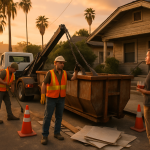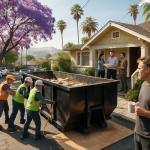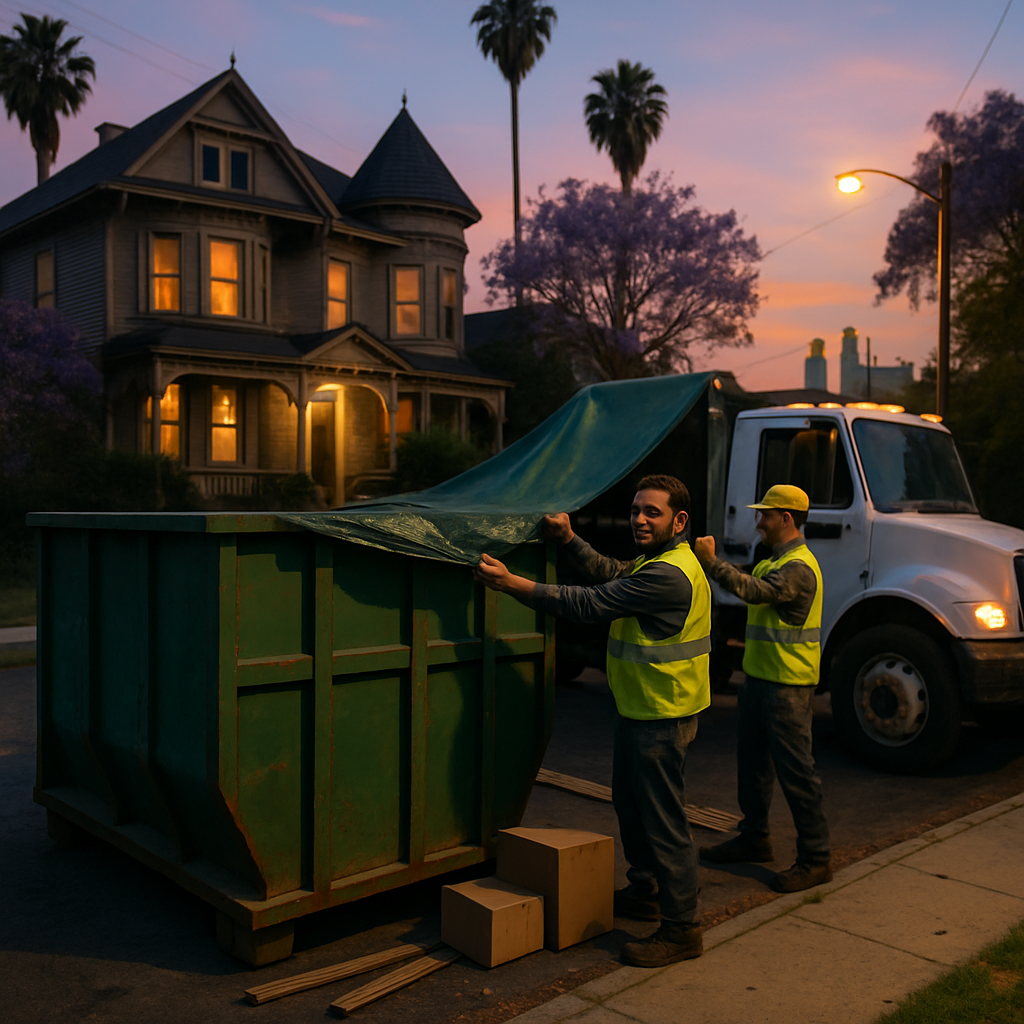
The dumpster arrived at dusk, a hulking green rectangle against the halo of streetlights and neon. It smelled of salty evening air from the coast and a faint diesel tang from the truck; nearby, a palm tree swayed and a radio muffled an old Stones song from a neighbor’s garage. Rosa stood on the sidewalk in Silver Lake with her hands in her pockets, watching Malik climb down from the cab. “You ever seen a house that needs this much clearing?” she asked, already knowing the answer.
The Hook: An Unexpected Job in Silver Lake
Rosa had bought the Victorian with plans to make it sing again, but what she found behind the living room door—stacks of old magazines, a mountain of broken chairs, a forgotten chest of drawers—made plans feel small. “The contractor said: ‘Get a dumpster,’” she remembered. Yet when the dumpster hit the curb, the neighborhood gathered like a flock of curious birds. From a balcony above, Mrs. Chang from Pasadena called down, “Be careful with the old paint cans!” That small warning would become an echoing lesson as the work began.
The Setup: People, Places, and a Route Through the City
Malik had been driving dumpsters around greater Los Angeles for a decade. He knew the city like fingers on a palm—Venice’s bike lanes, Torrance’s wide boulevards, the maze of alleys behind Burbank studios. Today his manifest included stops in Echo Park, Santa Monica, Long Beach, and a late call to a remodeling site in Glendale. “You learn the rhythm,” he told Rosa as he checked straps and placement. “You don’t just drop metal on asphalt—there’s planning. Permit here, homeowner there, and sometimes you have to light a candle for the meter maid.”
Rosa learned quickly that a dumpster job was a choreography: the right size for the work, the permit for the curb, and the knowledge of what could and couldn’t go in. Malik drew invisible lines in the air as he explained the sizes—”ten to forty yards, usually”—and their likely uses: a 10-yard for small cleanouts, 20-yard for kitchen remodels, 30 to 40-yard for major renovations. He spoke about weight limits, tipping fees, and transfer stations like Sunshine Canyon and South Gate where loads were sorted and weighed. Each term was a bead on a string of city logistics.
Rising Action: Obstacles on the Route
The first problem came from a city code Rosa hadn’t expected. The property sat on a narrow street; the dumpster’s wheels would have to live on the roadway. Malik wiped his hands and said, “We’ll need a right-of-way permit from LADOT for that curb placement, otherwise you get a ticket and a love letter from the city.” They went online while the sun dipped, discovering the temporary placement permit process, and learned that Los Angeles, like many cities—Santa Monica and Long Beach included—requires permits for on-street dumpsters and limits where they can sit. A half-hour later, the permit was applied for. Rosa felt the city as a living thing, full of rules and protective instincts.
Then came the hidden hazard: a box marked with a flaking red label. “Lead-based paint,” Malik said, one hand hovering as if to measure. He called a local household hazardous waste hotline and was reminded—”No paints, solvents, fluorescent bulbs, batteries, or asbestos in the dumpster.” The contractor sighed with the weight of it all: additional trips, added costs, a pause in the progress. “It’s not just about convenience, it’s about safety and fines,” the contractor muttered. These moments—small, bureaucratic, necessary—added tension to the project.
Key Insights Woven into the Story
Along the way, Malik taught Rosa more than mechanics. He explained that many cities in the Greater Los Angeles Area have construction and demolition recycling ordinances. “In LA County, a big chunk of demolition waste is supposed to be diverted from landfills,” he said, pointing toward a pile of lumber that smelled of cedar and old varnish. “We sort out metal, concrete, and clean wood. Recyclers pay for some of this, and it keeps fees down.” He described load-separation practices at transfer stations, where recyclables are pulled before landfill-bound materials are weighed.
Rosa learned the economics too: dumpster pricing depended on size, location, duration, and weight. Weekend deliveries or same-day pickups sometimes nudged the price higher. There were also overage fees if the dumpster sat longer than the rental agreement or if the weight exceeded limits. Malik advised, “Estimate generously. It’s easier to return a smaller dumpster than to deal with an overstuffed pile on your curb.” He added practical tips: measure driveway access, consider dumpster placement to avoid blocking neighbors, and always secure loads with a tarp for transport to avoid citations and roadside littering.
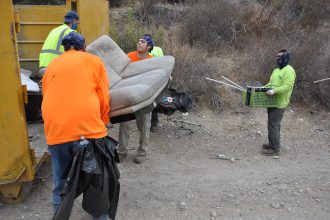
Throughout the route, Malik emphasized environmental steps that often got overlooked. E-waste—old TVs and microwaves—must be recycled at specific centers, not tossed. Mattresses and mattresses in some cities need special handling. Appliances containing refrigerants require certified technicians for removal. “When people try to get cute and put everything in one bin, we find ourselves sorting it later under the hot sun,” he said with a laugh that smelled of ozone and exhaust.
Scenes Across the City: Smells, Sounds, and Small Moments
Each stop had its own texture. In Santa Monica, a beach cleanup client filled a 20-yard container with sun-bleached planks and decades of festival detritus, the breeze smelling of kelp and sunscreen. At a Victorian in Pasadena, volunteers handed Malik old picture frames wrapped in moth-eaten cloth; their soft laughter contrasted with the clank of metal as the dumpster doors shut. In Long Beach, a construction crew unloaded broken tile that sparkled like tiny mirrors under the sun, sending motes of dust that shimmered in the light. In a narrow alley in Burbank, technicians in hard hats threaded a dumpster past studio trailers like a ship through a canal.
There were human beats too. A young woman in Culver City clutched a box of her grandmother’s records: “Keep those safe,” she told Malik. He nodded and placed them gently on top of a stack of styrofoam that he knew would be sorted for recycling. A couple in Brentwood argued quietly about whether to donate furniture; a volunteer from a thrift pickup promised to swing by. Each dumpster collected stories as much as waste, becoming a temporary archive of lives being edited and remade.
Turning Point: A Permit Delay and a Community Solution
On a Thursday morning, the contractor’s permit for street placement hadn’t cleared. The neighbors complained that the dumpster blocked the morning dog walk. Tension rose until Mrs. Chang, from Pasadena, lowered her binoculars and strode down to Rosa’s stoop with a tray of iced tea. “When we remodeled, the city made us do a permit too,” she said. “Why don’t we move this to Jamie’s driveway just for a week? He’s got the space and won’t mind.”
Jamie, who lived two doors down, agreed with a grin, and within an hour the dumpster sat under his jacaranda tree. The city permit caught up later that afternoon, but the small act of neighborliness had bought Rosa time and eased tempers. Malik watched the exchange, his face folding into a kind of contented exhaustion. “This city works better when people talk,” he said simply, pointing to an array of houses each with their own story and supply of patience.
Resolution: The Final Haul and a Cleaner Block
By the end of the second week, the Victorian had shed its old skin. The dumpster was nearly full—wood, plaster, broken ornaments, a rusty porch swing. The crew did a final sweep, sweeping up nails with a magnet and stacking the wood so it could be recycled or repurposed. Malik called the company for pickup and, as the truck approached, the neighborhood gathered. Mrs. Chang waved a dish towel like a flag, and the contractor clapped Rosa on the shoulder. “Feels lighter,” she breathed, the sort of simple, luminous sentence that makes the effort feel worth it.
At the transfer station, the load was weighed and sorted. Some of the materials went to recycling yards, some to local reuse centers, and a portion to landfills—unfortunately unavoidable in certain mixes. Malik exchanged receipts and a few wry jokes with the station attendant about the odd treasures that always appeared in dumpsters: old paperback romances, a child’s toy dinosaur, a cracked maraca. Each item had found its next destination by design rather than neglect.
Takeaway: What to Remember and Do
If you’re planning a cleanout or remodel in the Greater Los Angeles Area, remember a few things Rosa learned the hard way. First, choose the right size dumpster and factor in access and placement. Check local rules—Los Angeles, Santa Monica, Long Beach, Pasadena, and other municipalities often require permits for street placement. Know what’s prohibited: hazardous materials, e-waste, certain appliances, and paints need special handling. Ask about recycling and diversion—many companies and transfer stations will separate metal, wood, concrete, and recyclable materials to reduce landfill loads. Finally, communicate with neighbors and consider timing: weekend drops, HOA rules, and meter restrictions can all affect the process.
Rosa kept a small pile at the curb of things destined for donation and another of hazardous materials marked clearly for special pickup. She paid the bill, which included the dumpster, the tipping fees, and the permit, and felt satisfied not only because the house looked better but because the work had been done responsibly. Malik shrugged and said, “You did what a lot of people skip: you planned. That’s the difference between a mess and a project.”
As the truck rolled away, the city around them resumed its daily hum—buses hissed, a cyclist rang a bell, a gull cried from somewhere near the coast. The dumpster’s place on the curb was no longer a looming presence but an emptied stage where the next act would be built. Rosa stood in the warm light of early evening and felt, for the first time in months, how space makes room for possibility. A neighbor handed her a cup of tea, and for a brief, tender second, the city felt less like a tangle of rules and more like a community of people solving small, important problems together.
The final image stayed with her: the green dumpster, now clean and closed, reflected the sunset like a dark, patient monolith. Behind it, the Victorian’s windows glowed with new light—curtains pulled aside as if to wink at the future. In Los Angeles, where change is as constant as traffic, sometimes the simplest act—removing the old to make way for the new—feels like a small, quiet victory. When the dumpster’s lock clicked shut for the last time that evening, it wasn’t an ending so much as the city’s practiced exhale: organized, messy, hopeful, and already moving on.