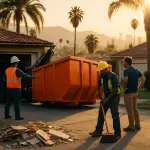
The first time I stood on the cracked sidewalk of a Craftsman in Echo Park watching a dumpster be lowered into place, the air smelled like hot tar and sawdust, and the city seemed to inhale with me. A sagging couch, a mountain of drywall, and a chorus of distant freeway horns made a strange kind of music. “We’ve got two hours before the permit runs out,” Sam said, wiping sweat from his brow as the sun pushed heat across the rooftops toward downtown.
Setup: A Neighborhood, a Project, and a Deadline
Maria and Javier had bought the 1920s bungalow two months earlier and imagined a kitchen that opened onto a small, planted yard. Instead they found a patched roof, decades of accumulated junk in the garage, and a contractor’s schedule that moved faster than city hall’s permit office. The house sat between the palm-lined blocks of Echo Park and the humming arteries toward Silver Lake, with Long Beach and Torrance projects done and dusted on Sam’s calendar already. “We need a 20-yard at least,” Javier told Sam, pacing with a blueprint under his arm.
Rising Action: Logistics Across the Greater Los Angeles Sprawl
That afternoon became a map of the city. The dumpster company called from a dispatch office in Burbank; the driver asked whether the dumpster would sit on the curb in front of the house or in the alley off Glendale. A permit? Yes—Los Angeles Department of Public Works nods in practice, even if not over the phone. “If you park it on the street in Santa Monica or West Hollywood, the rules are different,” the dispatcher said. “In Venice you’ll have to think about narrow streets and the canal houses. In Pasadena some neighborhoods enforce time limits.”
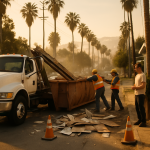
Neighbors peeked over hedges. An elderly woman from two doors down smelled the sawdust on her sleeve and asked, “Are you keeping the old tile?” Another neighbor from Culver City called to offer coffee. The dumpster arrival slowed to a theatrical cadence: the hydraulic whine, the thunk of steel meeting asphalt, the hiss of safety chains. The driver—an easygoing man with a Dodgers cap—deployed bright orange cones and a reflective sign, and profanity from a cramped convertible erupted two blocks away when the traffic funneled unexpectedly.
Key Insights Woven Into the Scene
Between the clatter of hammers and the rattle of nails, Sam explained the practical rules that saved them both time and money. “Match the dumpster to the job,” he said. “10 to 15-yard containers for small remodels or yard clean-ups; 20 to 30 yards for full kitchen or demo work. Ask about weight limits—concrete and soil add cost fast.” He pointed to a pile of gypsum dust and said, “Keep hazardous stuff out: paint cans, solvents, batteries. They don’t go in here.”
He also talked about donation and recycling options common across the region. “In Pasadena and Glendale, donation centers take gently used cabinets and fixtures. Long Beach has a robust recycling program for metals and appliances. If you’ve got usable stuff, call a local charity first—sometimes it’s picked up before the dumpster hits the curb.” The conversation drifted into timing—weekday deliveries to avoid rush hour from Inglewood to Hollywood, and how local haulers know which streets are too narrow for a drop. The lesson was practical: local knowledge saves money and red tape.
Resolution: Work, Sweat, and the City’s Quiet Gratitude
By sunset the house looked different. Where the living room had once held decades of furniture and layered memories, there was a clean, echoing space smelling faintly of lemon cleaner and new paint. The dumpster was full: plaster, old cabinets, a rusted heater that coughed once on the way in and fell silent. Maria stood with her hands on her hips, looking both exhausted and oddly triumphant. “I never thought I’d feel this way about a pile of trash,” she laughed, the sound bright against the climbing dusk.
The driver backed the dumpster onto the truck with a practiced motion, chains clinking like a soft percussion. He nodded to Sam and to the neighbors who had come out to watch. “See you in a few weeks for the yard soil,” he said. The truck rolled away, taillights blinking like mild stars along Sunset Boulevard folding into the evening.
Takeaway: What to Remember When You Need a Dumpster
If you live anywhere across the Greater Los Angeles Area—be it West Hollywood, Torrance, Venice, or the hills above Burbank—remember the choreography you just watched: pick the right size, check for permits, separate hazardous materials, consider donation options, and work with a local hauler who knows the streets and the rules. A dumpster is not just a metal box; it’s a small city within a city, regulated and negotiated, carrying old things away to make room for something new.
As the last light slid off the palm fronds of Echo Park and the skyline softened, Maria and Javier stood on their newly emptied porch. In the quiet that followed, the house finally sounded like the beginning of the project it had always promised to be: open, possible, and ready.