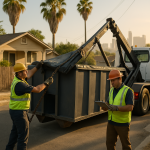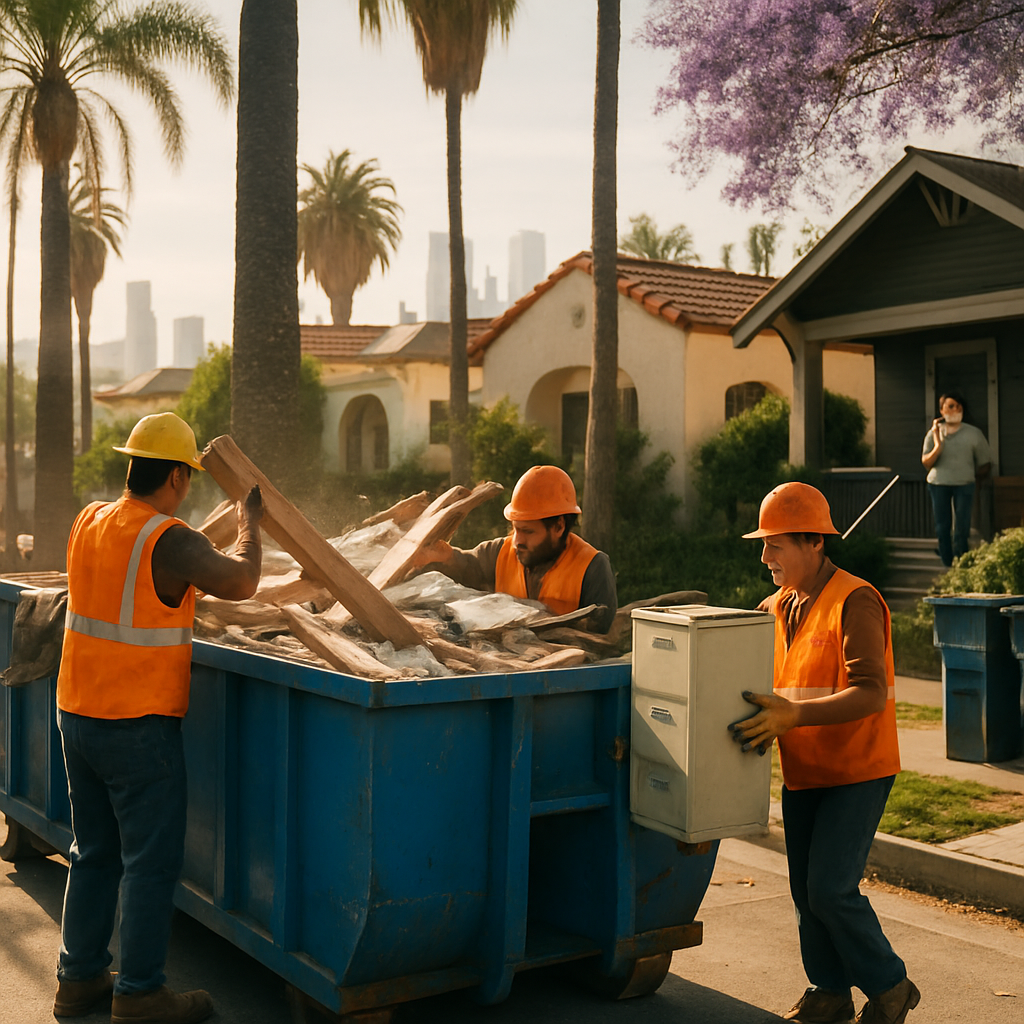
The morning the dumpster arrived in Highland Park, Maya nearly missed it — a low rumble under the jacaranda trees, the crunch of gravel, and a metallic clang that seemed to announce a small revolution. She stood on her front steps, coffee cooling in her hand, as a blue roll-off container the size of a minivan eased into place on her street. The men in orange vests spoke in quick Spanish; one tipped his hard hat and said, ‘We’ll be out by noon, señora.’ For Maya, this clunking, dusty box represented more than demolition waste. It was the line between chaos and completion for the old Craftsman she and her partner had vowed to restore.
Setup: The cast, the canvas, and a city that refuses to tidy up quietly
Greater Los Angeles spreads like an anthology of neighborhoods: the beach breeze in Santa Monica, the oil-slick sunsets over Long Beach, the hills of Pasadena, the neon in Hollywood. Each neighborhood has its own rhythm and its own relationship with trash. On this block, row houses leaned together like family, and the street smelled faintly of eucalyptus and motor oil. Maya’s contractor, Jose, was short, quick-witted, and adept at translating city regulations into practical plans.
‘You want that dumpster here for three days, or a week?’ Jose asked, handing her a checklist. ‘Permit? I can get one. But if the sanitation truck comes and it’s blocking the route, we’ll get fined.’ Maya realized there were more layers to renting a dumpster than she’d imagined — timing, permits, size, weight, and the local personalities who would judge a pile of demolition in their view.
Rising action: Timing, neighbors, and the first load
The first morning, the dumpster seemed almost too quiet. Then a cabinet door gave way, and with it came the sound of a decade of living: nails, plaster, a smell of decades-old paint. Mrs. Alvarez from next door peered over the hedge. ‘Be careful with that old insulation,’ she warned. ‘My sister had to call a specialist once.’ The warning hung in the air. Maya’s heart thudded; there were fewer things more frightening than an unknown material labeled ‘old.’
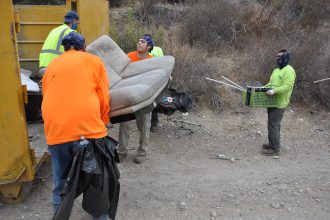
‘We’ll test it first,’ Jose said. He called his crew over, and they unpacked a small kit with gloves, goggles, and test strips. They separated loads: wood and plaster in one corner, metal scraps in another, and cardboard that could be flattened and recycled. Neighbors began dropping by — a handyman from Echo Park with a bar of rusty pipe, a mother from Mount Washington wanting to get rid of a mattress. Each item nudged the dumpster’s capacity upward and raised questions: do old mattresses go in the roll-off? What about the cracked window from the back porch?
Some items are simple: drywall and wood are typical construction debris. Others travel a different route. ‘No tires,’ Jose said. ‘Paint and batteries go to hazardous waste centers — the city doesn’t want that in a landfill.’ The first day evolved into a choreography of decision-making: what was allowed, what could be donated, and what had to be handled specially.
Key insights: What dumpster removal looks like in Greater Los Angeles
Between cups of coffee and the shuffle of debris, Jose explained the lay of the land and the practicalities that bind this city together.
‘Sizes matter,’ he said. ‘We have 10, 20, 30, and 40-yard roll-offs. For a small kitchen remodel in Culver City, a 10 or 20-yard is enough. For a garage clearance in Burbank? Go 30. Whole-home gut jobs in San Pedro or Torrance? 40 yards, and don’t be surprised by weight fees.’ He pointed to the dumpster’s low metal lip. ‘It’s easier for loading. But remember: if you need it on the curb, you might need a permit, especially in Pasadena or the Westside.’
The permit system in Los Angeles and surrounding cities is a patchwork. Some neighborhoods allow a dumpster on the street with a simple online application; others, like parts of Santa Monica near the boardwalk, require stricter placement to avoid blocking pedestrian routes and local events. There are parking restrictions, street-sweeping schedules, and in certain historic districts — like parts of Pasadena — additional reviews to maintain street aesthetics. Jose also emphasized weight limits: concrete, dirt, and heavy tile can trigger overage charges, and the scales at disposal facilities in Long Beach and other regional centers are merciless.
Recycling and donation opportunities were never far from the conversation. ‘Lots of folks think everything goes to the dump,’ Maya said later, while carrying a box of gently used fixtures down the front path. Jose shook his head. ‘Nope. Metal goes to recycling yards, wood can become biomass or be salvaged, and usable fixtures? Donate to ReStore or a local charity in Inglewood or Highland Park. It’s cleaner and cheaper.’
Midpoint: A complication and a neighborhood meeting
By the fourth day, the dumpster was half full, buzzing with the business of transformation. Then a truck came down the street, music spilling from its open windows. The driver pulled over and began to unload: furniture he claimed was ‘nonprofit-bound.’ Mrs. Alvarez watched with narrowed eyes. ‘You can’t just add to somebody else’s rental,’ she chastised. ‘What if there’s asbestos? Cost goes up.’
Maya felt responsible. The unexpected addition brought home the complexity of shared spaces. Jose calmed the truck driver and explained liability. The man sighed and admitted he hadn’t asked. ‘I thought it would help people clean up faster,’ he said. ‘I didn’t think about the permits or testing.’ The crew separated out suspicious items and called a local hazmat contractor from Glendale to test suspect insulation. The results came back: not asbestos, just old cellulose with paint chips. Relief washed across the street like a tide.
That evening, neighbors gathered on the sidewalk, a block party of concern and curiosity. They shared tips: where to find same-day dumpster rentals, how to apply for curb permits in Glendale and Burbank, and which Long Beach disposals accepted mixed construction debris. They also shared stories — an eviction cleanout gone wrong in Hollywood, a kitchen that turned into a cascade of surprise pipes in Culver City. By the time the sun dipped behind the palms, the dumpster felt less like a piece of metal and more like a community ledger of what they were ready to let go.
Resolution: The last load, the final sweep, and a neighborhood transformed
On the final day, Jose and his crew made the last sweep. They carried out the reclaimed crown molding that would become a shelf, the vintage light fixtures destined for donation, and the last sagging beam. Maya walked through the house after the crew left, breathless at how empty rooms echoed new possibilities. Outside, the dumpster was nearly full, its walls lined with the remnants of a life edited intentionally.
‘You did good,’ Mrs. Alvarez said, leaning against the fence, pride soft in her voice. ‘This street needed that.’ Maya looked down the block: kids playing hopscotch, a delivery cyclist weaving around a parked truck, the distant outline of the Griffith Observatory catching the late light. The city felt both intimate and immense.
The crew drove off in a cloud of dust, and within an hour they returned with a clean tarp to secure the load and a receipt noting proper disposal. Jose explained the paperwork: receipts for disposal weight, manifests for hazardous items, and tags for recycled materials. These were not just bureaucratic scraps — they were proof of responsible stewardship in a city where every ton of waste has a story.
Takeaway: Practical tips and what to remember
If you find yourself standing where Maya once stood, here are the essentials to carry with you:
‘Plan the size and schedule: Small jobs — 10 to 20 yards; medium — 20 to 30; major gut jobs — 30 to 40. Confirm how long you need the dumpster and whether you’ll need pickup and swap services.’ Jose’s voice in Maya’s memory was practical and kind.
‘Check permits early: Curb placement in Los Angeles, Santa Monica, and Pasadena often requires a permit. Allow extra time in tourist-heavy or historic districts.’
‘Separate materials: Metals, cardboard, and some wood can be recycled; fixtures can be donated; hazardous materials such as paint, batteries, and fluorescent bulbs need special handling at designated centers, often in Long Beach or regional transfer stations.’
‘Mind the weight: Heavy items like tile and concrete add up quickly and can incur overage fees. Ask about per-ton charges and whether you can sort out heavy debris separately.’
‘Secure the load: Use tarps, straps, and proper disposal techniques to avoid fines and spillage — especially important on windy days in coastal neighborhoods like Santa Monica.’
‘Hire experienced crews: They know local routes, permit rules, and disposal yards. They’ll help separate hazardous items and reduce your liability.’ Jose’s last advice hovered with the sunset: ‘It’s about respect. For your home, for your neighbors, and for the land we all share.’
When the dumpster finally left, it took with it a chorus of dust motes that glittered in the late light. The house looked smaller without its history of stuff, but in the rooms, possibilities rose like light: a kitchen that would open to the backyard, a new floor that would remember footsteps. Maya set her coffee cup on the counter and listened. In the distance, a city kept moving — trucks on the 101, surfers near Venice, a street vendor setting up near Echo Park. The dumpster had been temporary, but the choices they’d made — recycle, donate, test, permit — felt permanent, part of a quieter promise to the neighborhoods of Greater Los Angeles: that progress need not mean waste without thought. She stepped outside and, for a moment, the city felt like an orchestra where every player had a role, even the humble dumpster.
In the end, the final image was simple: a clean street under a wide California sky, palm fronds tracing slow shadows, and the faint smell of sawdust mixing with ocean air. The dumpster was gone, but the work it enabled remained — a restored home, neighbors who had learned one another’s names, and a stack of receipts proving that, for once, everything went where it should.