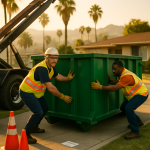
The first time I smelled the ocean through a stack of plywood and drywall, I was standing in a driveway in Venice, watching a red roll-off dumpster breathe in the late afternoon light. A stray breeze carried salt and the faint roar of a lifeguard’s whistle; inside the bin, the house’s old insulation exhaled decades of cigarette smoke and memory. Who would have thought that a box of metal and lumber could tell stories about a neighborhood? In Los Angeles, dumpsters do more than hold trash—they navigate alleys, city rules, and human lives.
Setup: Characters, Streets, and a Project
There were three of us that day: Rosa, the contractor with paint under her nails and a laugh that can quiet a neighborhood dog; Miguel, the driver who knows every back road from Long Beach to Malibu; and me, the homeowner juggling a renovation and a stack of permit forms. We were in a narrow Echo Park street lined with eucalyptus trees, hummingbirds darting between blossoms. The house—an aging Craftsman with sun-bleached shingles—had been in my family for generations. It needed a new kitchen, new windows, and the sort of demolition that turns living rooms into treasure troves and hazards.
‘Measure twice, order once,’ Rosa said, tapping her tape measure against her knee. ‘You don’t want a dumpster too small. Trust me—nothing good happens when the lid is overstuffed.’ Miguel unloaded his clipboard, stamped with a dozen different companies’ logos, and we talked sizes: 10, 15, 20, 30, 40 cubic yards. Each number conjured visions of wood, metal, tile, and the peculiar smell of a house being reborn.
Rising Action: Streets, Permits, and the Tight Turn
Ordering a dumpster in Los Angeles isn’t just a phone call—it’s a choreography. Some streets in Silver Lake are so narrow that a roll-off needs a chess player’s eye; Beverly Hills demands impeccably timed deliveries to avoid valet-fueled gridlock; Santa Monica often has beach-loving pedestrians and a city permit process that calls for polite patience. Miguel had a route planned: pick up the permit from the city’s online portal, call when he’s fifteen minutes out, thread the truck past a farmer’s market in Culver City, and avoid the low tree limb on Alvarado between Echo Park and Koreatown.
‘You ever had to back a forty into a driveway under a ficus?’ Miguel asked, smiling at Rosa. ‘You learn to speak with your hands more than your engine.’ He wasn’t joking. When the truck arrived, neighbors peered over hedges. A delivery in Torrance will smell different—salt and diesel, with the harbor’s distant horns—than one in Malibu, where sand and eucalyptus perfume the air. Each neighborhood has its senses and its rules.
There was a hiccup when the city inspector called. ‘Temporary placement in a public right-of-way requires a permit,’ she said. I could imagine the little red stamp hidden inside some municipal inbox. In Los Angeles, the Department of Transportation sometimes asks for a parking permit, and in Long Beach a separate solid waste notice might apply. Miguel swatted it away with a grin. ‘We got this,’ he said. ‘But we’ll need to move it two feet to avoid a root.’ We moved the dumpster, adjusted the driveway mats to protect the concrete, and listened as the neighborhood settled back into its rhythm—woof of a dog, clack of a neighbor’s stepladder.
Key Insights Woven Into the Story
As the demolition began, each swing of the sledgehammer taught a lesson. Rosa sorted materials, laying a path of intention through the chaos. ‘Keep the metals separate,’ she said, lifting a rusted pipe with careful hands. ‘They fetch recycling money, and they don’t belong to the landfill.’ Miguel pointed out the little sticker on the dumpster’s rim: ‘No hazardous materials.’ ‘Batteries, paint, propane—you can’t throw those in here,’ he warned, miming a dramatic eye roll at the thought of someone tossing a gas can.
Here are the practical takeaways we learned between flying plaster and the hush of a Santa Monica fog rolling in:
- Dumpster sizes matter: 10–15 yard dumpsters fit small cleanouts and minor renovations; 20–30 yards suit typical kitchen remodels or garage cleanouts; 40 yards are for major renovations or construction jobs. Estimate generously—overfilling is more expensive and unsafe.
- Weight limits are real: Most cities and companies enforce tonnage caps. Heavier loads—like concrete or dirt—can spike the cost due to landfill fees. Spread heavy loads evenly to avoid fines and damage.
- Permits and placement: If the dumpster sits on the street, many LA-area cities require temporary occupancy permits or parking clearances. Placing on driveways helps avoid permits but may need mats or boards to protect surfaces.
- Prohibited items: Paint, pesticides, batteries, medical waste, asbestos, and compressed cylinders usually aren’t allowed. Contact local hazardous waste facilities—LA Sanitation and other county programs run regular collection events.
- Recycling and diversion: Separate wood, metal, and clean concrete where possible. Many companies partner with recycling centers in Long Beach and San Pedro; donation centers in Culver City and Pasadena can take salvageable furniture and cabinetry.
- Schedule smart: Avoid delivery during heavy traffic hours, big events in Hollywood, or beach weekends in Santa Monica and Venice. Ask for a window and a confirmation call.
As the bin filled, we made a ritual of small decisions. That rusted lamp? Donated to a local thrift in Glendale. The usable cabinets? Listed online, picked up by a single dad who wanted to fix up his kitchen in East Hollywood. The old vinyl siding? Recycled with a contractor who makes composite decking. Every item had a possible afterlife, and the dumpster became less of a grave and more of a crossroads.
Midpoint: Tensions, Neighbors, and a Rainstorm
Halfway through, the neighborhood test of patience began. A neighbor in a bungalow across the street complained about noise. ‘This is my living room—it’s creeping into my TV time,’ she said, hands on her hips. Rosa brought her a cup of coffee and explained the timeline; Miguel moved the truck to create a bit more distance. People in Inglewood knocked on doors to ask about parking; a kids’ soccer practice in Pasadena interrupted the route for a day. Even the weather conspired: a surprise windstorm blew in from the coast, scattering insulation like confetti. It smelled like warm rain on a hot sidewalk—something uniquely Angeleno.
That evening, sitting on the curb with a slice of pizza from the neighborhood place in Silver Lake, I thought about how waste management in Los Angeles is also a matter of civics and courtesy. Properly coordinating a dumpster delivery means talking to neighbors, checking city rules, and planning for weather. It meant treating the street as a shared space, not an obstacle course.
Resolution: The Haul-Away and the Quiet After
When the truck returned to haul the dumpster away, the sound of the hydraulic lift felt triumphant. Miguel backed up with the calm of someone who’s handled thousands of loads. The bin, now a mosaic of broken tiles and bundled lumber, glowered at the sky. We checked the load ticket—weights declared, materials noted. The truck turned toward San Pedro’s transfer stations and recycling yards, then toward Long Beach where metal collectors were waiting.
‘You know,’ Miguel said as we watched the truck disappear down Sunset, ‘people think we just take things away. But we also send things on journeys. Some of these pieces will be turned into rebar, some into art, some into mulch that will go back into someone’s yard.’ Rosa nodded. ‘That’s the point—this house gets its heart fixed, and the city keeps spinning, a little cleaner.’ The driveway felt empty but lighter, as if the project had simply exhaled.
Takeaway: What to Remember and Do
If you’re planning a renovation in Greater Los Angeles, here are the things to remember—learned in the spray of dust, the clap of roller shutters, and the neighborhood chats that filled our days:
- Plan for size and weight. Pick a dumpster that matches the scope: 20–30 yards for moderate remodels is a common sweet spot.
- Check city rules early. Whether you’re in Los Angeles, Beverly Hills, Santa Monica, or Long Beach, municipal sites outline street permit requirements and temporary occupancy rules—call the city’s customer service if you’re unsure.
- Protect surfaces. Use driveway mats or boards to prevent damage, especially under heavy units.
- Separate what you can. Metals, concrete, and clean wood often have higher recycling value and lower disposal costs.
- Avoid hazardous items. Use designated hazardous waste drop-offs or collection events for paints, solvents, and electronics.
- Communicate with neighbors. Let them know delivery windows and timelines. A little courtesy goes a long way in neighborhoods from Echo Park to Torrance.
We signed the final invoice as dusk painted the palm trees in silhouette. The house looked like itself again—only clearer, more honest. Families in Beverly Hills and condos in Koreatown might not share the same skyline, but they share the same rhythm: a project starts with noise and dust and ends with a space that breathes. Miguel waved, and the neighborhood resumed its ordinary glow—porch lights flicked on, a radio hummed a familiar tune, and someone barreled down the block on a skateboard.
In the weeks after, I saw the dumpster’s remnants find new places. A salvaged banister became a coat rack in a Glendale eatery. Reclaimed tile paid for a community mural in San Pedro. The craft of removal wasn’t just hauling away; it was rerouting material and meaning. That’s the memory I carry: the image of an emptied driveway at twilight, the ocean breeze mingling with the scent of sawdust and new paint, and the city stretching, relentless and renewing, under a sky that seemed a little bit cleaner than before.
And if you ever find yourself watching a dumpster roll down a Los Angeles street, listen for the city’s conversation in the clink of metal and the rustle of packing straps. Behind every pickup slip is a small miracle of logistics and a story—ending, beginning, and continuing all at once.