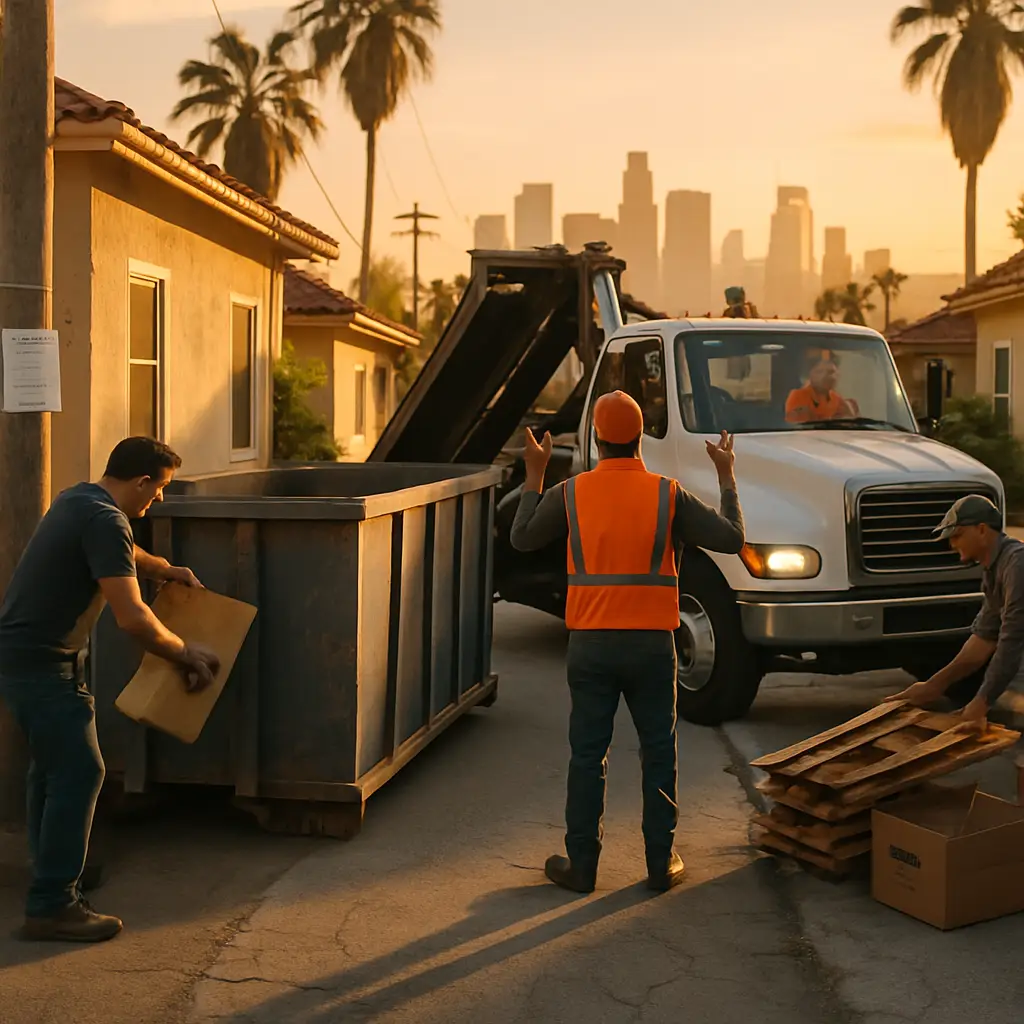
The dumpster arrived on a Tuesday morning that smelled of coffee and hot asphalt, the city already humming with its usual freeway lullaby. I watched from the kitchen window as a low-slung truck reversed slowly into the alley, the driver’s orange vest flashing like a warning beacon. It was the sort of ordinary interruption that becomes extraordinary when you’re standing in a house full of things you no longer want—and a pile of decisions about what to keep, what to toss, and what to recycle.
Morning on Magnolia Avenue
Maria, who had lived in Echo Park for eight years, leaned against the counter holding a steaming mug. ‘If the container doesn’t fit,’ she said, ‘we’re calling it a day and living in boxes forever.’ Her father, painting a dented dresser in the garage, laughed and said, ‘Don’t worry, honey. They know these alleys. They’ve danced these turns a hundred times.’ Outside, the crew cracked the lid of the dumpster with a metallic thud that echoed between the brick and stucco of the old bungalows.
Setting the Scene
Greater Los Angeles is a city of narrow streets and wide ambitions. Between palm trees, taco trucks, and the ever-present glint of the Hollywood Hills, space is a premium. The dumpster team — two men and a woman — unfolded ramps, marked a no-parking permit taped to a lamppost, and placed the container so the alley could still serve as a thoroughfare for neighbors. The sound of diesel mingled with distant sirens; a gull circled above, attracted perhaps by the promise of stray food wrappers.
Rising Tension in the Alley
At first, clearing the house felt cathartic. Old textbooks slid into boxes; a broken lamp clanged as it hit the metal. But then the questions began. ‘What about the old paint cans?’ Maria asked. ‘And the mattress—does that go in here?’ The crew leader, Javier, knelt and explained in a patient voice: ‘We take most construction debris, furniture, and general junk, but no hazardous materials. Paint, chemicals, and electronics often need special handling or a trip to the hazardous waste center. Mattresses can be accepted but sometimes cost extra if we have to take them to a special facility.’ His hands were small but deft, directing where a stack of plywood should go, where the boxes should be flattened to save space.
Practical Lessons between the Tosses
As items disappeared into the container, practical lessons surfaced like treasures in the rubble. Size matters: residential dumpsters typically range from 10 to 40 cubic yards. A 10–12 yard bin can handle a small garage cleanout; a 20–30 yard model is common for home renovations. Prices in L.A. often vary by size and weight—expect a small roll-off to start around $250–$400, a mid-size 20-yard around $350–$600, and larger 30–40 yard bins anywhere from $500 to $900 or more depending on tonnage and permit needs.
‘We also factor in drive time,’ Javier added, wiping sweat from his forehead under the sun—because in L.A., traffic can turn a ten-minute haul into an hour. ‘If the landfill’s farther or you’re in a congested zip code, that’ll affect your price.’ He unfolded a small permit from his pocket. ‘And if it needs to sit on the street, you’ll often need a city permit — the Department of Transportation wants to make sure it’s not blocking street sweeping or parking during peak hours.’
Sorting, Saving, and the City’s Rules
By noon, the pile beside the dumpster had shrunk. Maria and her father debated over a box of old children’s books. ‘We could donate these,’ he suggested, holding up a battered copy of Where the Wild Things Are. Donating, recycling, and diverting materials from landfills is not just noble in L.A.—it’s practical. Many local companies separate recyclable metals, wood, and concrete for C&D recycling facilities. Electronics, batteries, and paints need to be taken to designated hazardous-waste drop-off sites or scheduled for special pickup through Los Angeles Sanitation.
The Moment of Truth
By the time the sun leaned toward the hills, the dumpster stood half-full and the house exhaled. A neighbor wandered by, smelling the scent of eucalyptus from a nearby yard, and asked, ‘Did you get a permit?’ Maria held up the laminated copy. ‘Yes — and I booked pickup for Saturday. They said if it’s overweight or has prohibited items, they’ll charge an overage or ask us to remove it.’ The uncertainty that came with the heap of possibilities—what the city allows, what haulers accept, how to keep costs down—had been cut down to a few clear steps.
Finishing the Job
The crew secured the dumpster’s lid and chalked the curb with return times. The clack of metal settling was a punctuation mark. ‘We try to keep the mess minimal and the recycling maximum,’ Javier said. He loaded the truck with practiced motions, the engine’s rumble a low drumbeat. Maria stood with a sense of lightness she hadn’t had in months; the house felt like it could breathe again.
A Last Image
When the truck pulled away, the alley returned to its usual rhythm—dogs barked, a bicyclist rang his bell, and a breeze carried the faint scent of lemon from a nearby tree. The dumpster, a temporary island of possibility, receded with the city skyline glinting behind it. Maria closed the door, the sound oddly final and liberating at once. Keep what matters, give away what doesn’t, and call the right people when the heavy stuff needs to go: that’s the lesson here, wrapped in the ordinary drama of a Tuesday morning in Los Angeles.
Takeaway
When you need a dumpster in Greater Los Angeles, plan ahead: choose the right size, ask about weight limits and prohibited items, secure permits for street placement when necessary, and consider donation or recycling first. And when the truck comes, listen to the crew — they’ve learned the city by the mile and the alley. That way, you won’t just remove clutter; you’ll create space for whatever comes next, and maybe, like Maria, you’ll catch the way the sunlight slides across an empty garage and know you’ve made room for something better.