By the third day the upstairs remodel looked less like progress and more like an avalanche—sawdust trails, a chandelier wrapped in bubble wrap, and the couch standing on its head like a shipwrecked thing. Marisol pressed her palm to the hot stucco of her Echo Park bungalow and asked the question that had nudged her awake for a week: where do all these mountains of debris go?
Setting the Scene: Morning Heat and Concrete
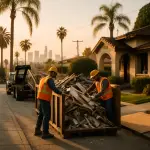
The city smelled like coffee and hot asphalt. A roll-off truck idled at the curb, its diesel heartbeat vibrating through the soles of my shoes. Across the street, a man in a reflective vest squinted at a laminated permit like it was a foreign language. “Parking’s tight with the tree,” he said. “We’ll have to back it in from Glendale Avenue.” Down in Long Beach, an architect named Jamal was coordinating a townhouse gut-job while listening to the faint roar of the harbor; in Santa Monica, Lena negotiated quiet-hour rules with a tenant who loved late-night demolition. Different streets, same problem: where to put a dumpster so the cleanup can actually begin?
Rising Tension: Rules, Narrow Alleys, and The HOA
“We need a permit if it’s on the curb,” the driver explained as he pointed to a scratch of white paint marking the loading zone. His name was Carlos; he’d been hauling through Hollywood, West Hollywood, and Burbank for a decade. He told us stories of tight alleyways in Pasadena where mirrors folded in and out like a funhouse, of Beverly Hills homeowners who demanded palm-leaf proof of removal schedules, and of Torrance sites where weight limits were enforced by the minute. When I asked about cost, his answer was honest and human: “It’s not just metal and wood—you’re paying for travel, tipping fees, and the headache of permits sometimes.”
The tension builds when you imagine the truck arriving and being told to leave because of a city ordinance, or finding out the pile contains paint cans and old batteries that can’t travel to a standard landfill. “You can’t put hazardous waste in a dumpster,” Carlos said, kicking the gravel. “No fluorescent bulbs, no solvents. Those have to go to a household hazardous waste site.” That was when the tightness in Marisol’s chest—equal parts anxiety and determination—gave way to a checklist scribbled on the back of her receipt.
Key Insights Woven into the Story
As the afternoon sun shifted, we learned the practical rhythms of dumpster removal across the Greater Los Angeles area. A 10-yard container fit a bathroom demo and cost less; a 30-yard beast was better for full-home cleanouts. City of Los Angeles curbside placement often requires a street-use permit, while some suburbs like Pasadena or Long Beach may ask for temporary parking permits or confirmation that the alley can handle the weight. If you’re in Culver City or Inglewood, alerting neighbors goes a long way—curbside dumpsters can block visibility, and an unhappy neighbor can escalate things faster than a full dumpster can fill.
There are smart ways to save money. Separate recyclables and donate reusable items to local charities in Hollywood or Glendale. Schedule pickups early in the week to avoid weekend tipping surcharges. Ask the provider about weight limits; an overfull 20-yard container can trigger surprise fees. And always, always mention any construction materials—tile, concrete, metal—because those alter where the load must go and what it will cost.
A Human Moment: Dialogue on the Curb
“Do you ever get sentimental?” Marisol asked the driver as he guided the dumpster into place by the alley behind her house. He paused, hands steady on the controls, and smiled at the way a piece of sunlight caught the edge of the metal. “Sometimes,” he said. “You find a letter in a pile or a kid’s drawing. Most days it’s just job after job, but every now and then it reminds me why people clean up.” He spoke softly as if sharing an old habit, and I thought of the woman in Beverly Hills who’d cried when the last of her late husband’s workshop tools were cleared away—grief being packed into blue contractor bags and taken to the county transfer station like anything else, but handled with a little more care.
Resolution: The Alley Breathes Again
By sunset, the dumpster sat where debris had been an hour before, a promise more than a receptacle. Carlos waved as he locked the container and adjusted the cones, and I could see the neighborhood easing—the way a held breath finally leaves a body. The truck’s taillights blinked like slow fireflies as it backed out, heading toward Sunshine Canyon and other municipal facilities, where loads are sorted, recycled, or buried under layers of city policy and earth. The house no longer looked wrecked; it looked staged for new life.
Takeaway: What to Remember
When you’re staring down a heap of drywall, furniture, or yard waste in the Greater Los Angeles Area, remember to measure the space, check permit requirements for Los Angeles, Long Beach, Pasadena, and your own city, sort recyclables, and talk to your provider about weight and prohibited items. Communicate with neighbors and plan for the weather—Santa Monica breezes can scatter lightweight debris in minutes. And if you’re unsure, ask the driver; every haul has its small, human rules that don’t always show up on a website.
As dusk cooled the air, the last light picked out the curve of the dumpster’s lip, and for a moment it looked less like a container and more like a boat anchored after a storm. We locked the gate, swept the alley, and let the neighborhood breathe. Marisol stepped onto the porch, cupped her hands around a mug of cooling coffee, and watched the taillights recede. “It’s amazing,” she said, voice low. “Like starting over.”